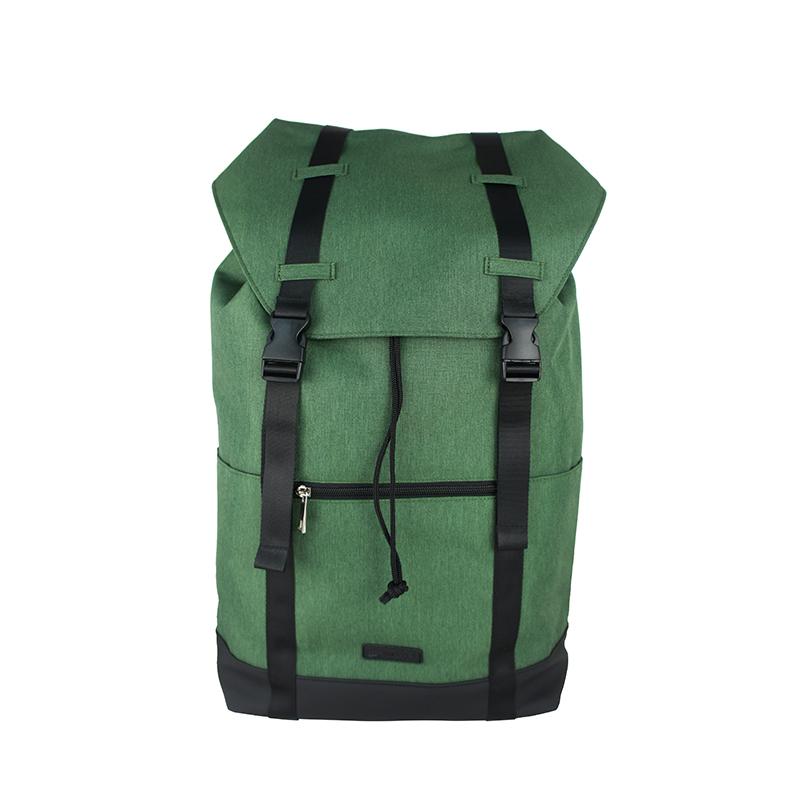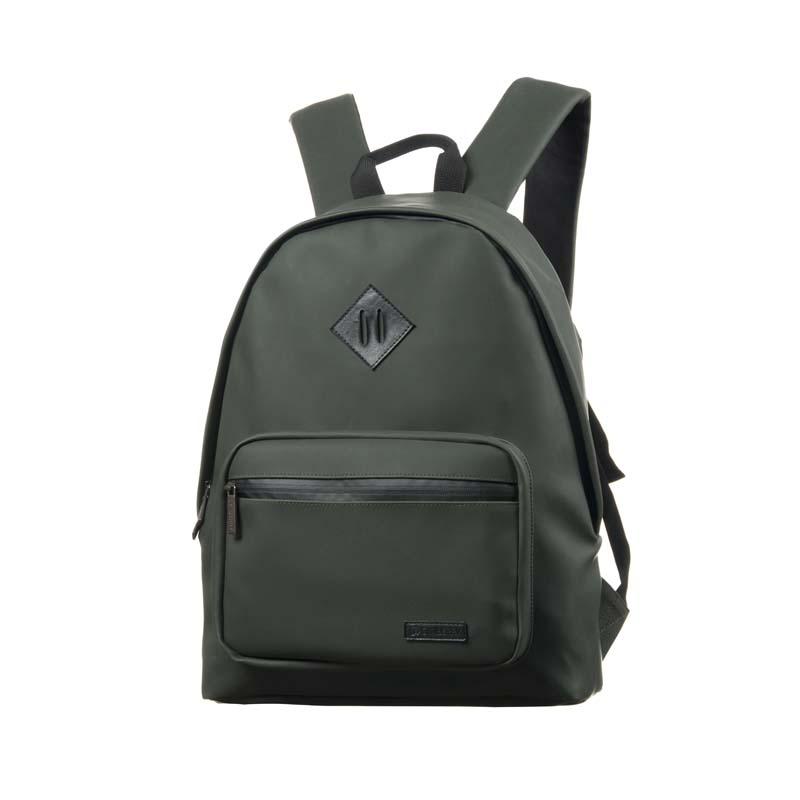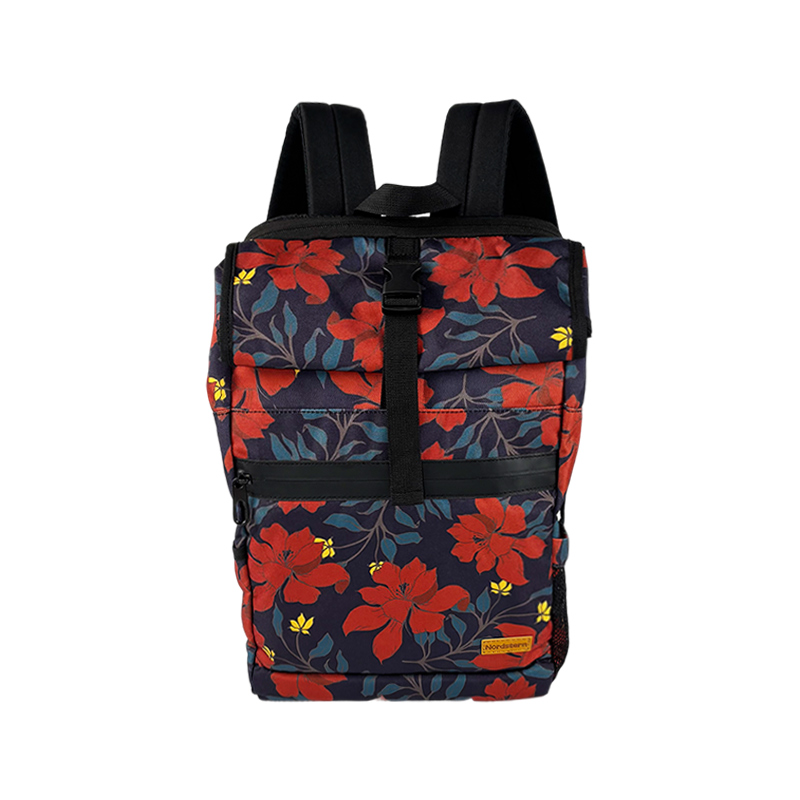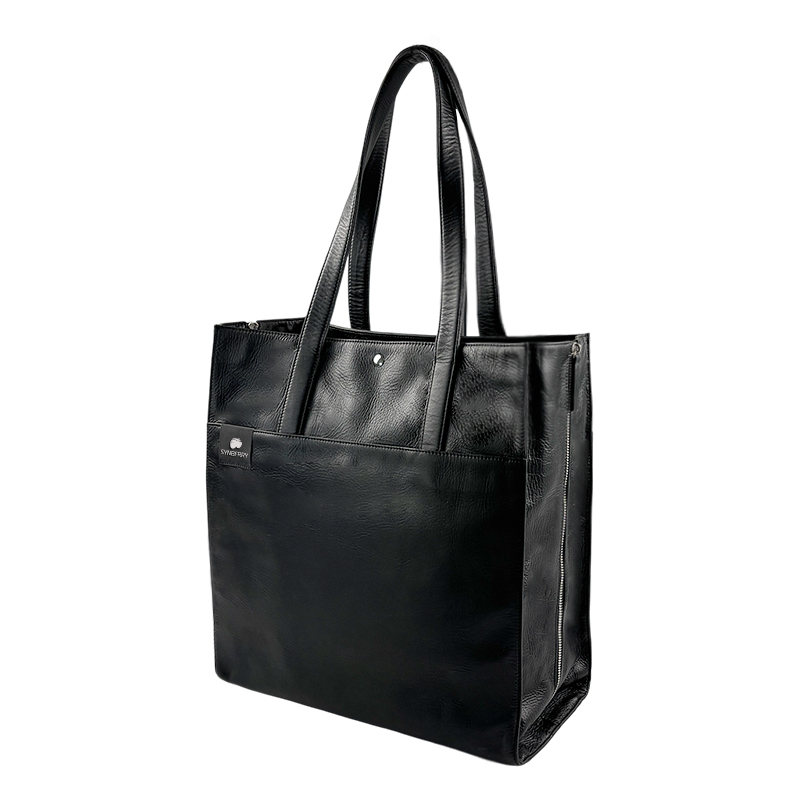




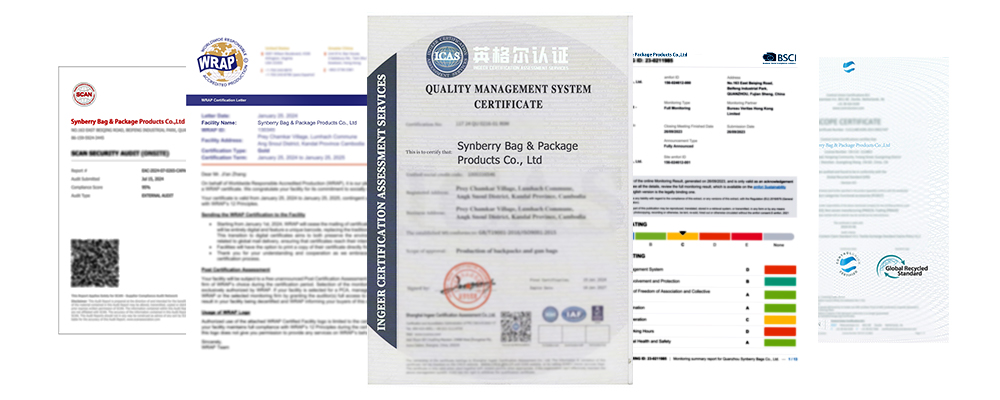
Synberry ist nach BSCI, WRAP, SCAN, GRS und ISO zertifiziert und gewährleistet so höchste Qualität und nachhaltige Produktionsstandards.
Unser professioneller Produktanpassungsservice setzt Ihre Idee in die Realität um und sorgt für ein nahtloses Erlebnis vom Konzept bis zur Produktpräsentation im Verkaufsregal


Mit Fabriken in China und Kambodscha haben Sie die Flexibilität, den Produktionsstandort auszuwählen, der je nach Ihrer spezifischen Situation die vorteilhaftesten Tarifvorteile bietet.

Was hat Synberry zur Wahl zweier Generationen gemacht? Mit klar definierten Qualitätsgrundsätzen, gut geführter Dokumentation und Aufzeichnungen und vor allem einer eingehenden Prozessanalyse und -prüfung sind wir in der Lage, eine gleichbleibend hohe Qualität sicherzustellen.

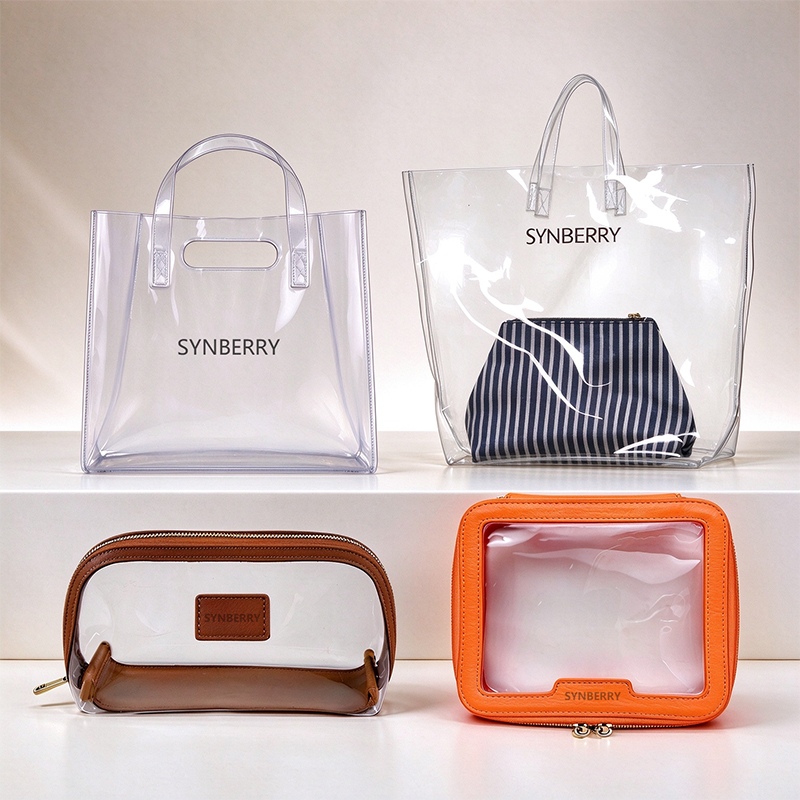
During the OEM production of transparent bags, PVC, EVA, and TPU are the three most frequently mentioned materials. Among them, PVC has the widest range of applications, TPU offers the most balanced overall performance, while EVA is irreplaceable in specific applications due to its soft feel. Taking common transparent bag applications as examples: PVC, with its highest transparency and lower raw material cost, has long dominated the markets for fast-fashion packaging, promotional gift bags, and mass-produced transparent handbags; TPU, thanks to its excellent elasticity and recovery, low-temperature resistance, and abrasion resistance, has become the preferred choice for high-end cosmetic bags, outdoor waterproof bags, medical device packaging, and transparent storage products that require repeated use; EVA is more commonly used in baby products, stationery pencil cases, and as a lining material in multilayer composite structures where softness and cushioning are important requirements. Table of Contents Differences in Composition Differences in Performance Environmental Friendliness, Compliance, and Safety How Should Brands Make Their Choice? Frequently Asked Questions (FAQs) I. Differences in Composition PVC (Polyvinyl Chloride): PVC is a chlorine-containing vinyl polymer that is inherently rigid. Plasticizers (most commonly phthalates such as DOP/DEHP) must be added to make it into a soft, transparent film. Among the three materials, PVC offers the highest transparency and the strongest “crystal-clear” appearance. It also has the lowest raw material cost, which is why PVC has long dominated the low-end transparent bag market. EVA (Ethylene-Vinyl Acetate Copolymer): EVA is a copolymer of ethylene and vinyl acetate. Its softness is determined by the vinyl acetate (VA) content in the molecule: the higher the VA content, the softer and more transparent the material. EVA has natural flexibility without the need for plasticizers, which is the most fundamental difference between EVA and PVC. TPU (Thermoplastic Polyurethane): TPU is a block copolymer whose molecular chains contain both hard segments (which provide strength) and soft segments (which provide elasticity). As a result, it combines the elasticity of rubber with the processability of plastic, making it the only “elastomer” among the three materials. II. Differences in Performance 2.1 Transparency and Appearance: PVC > TPU > EVA PVC: Offers the highest light transmittance and the lowest haze, creating a visual appearance closest to “glass.” TPU: Ranks second in transparency. High-transparency TPU films can achieve light transmittance of over 90%. EVA: Typically has a light transmittance of around 85% and may appear slightly translucent, especially when the VA content is high. It offers the soft texture of “frosted crystal” rather than the sharp, crystal-clear transparency of PVC. 2.2 Softness and Hand Feel: EVA > TPU > PVC EVA: The softest of the three materials. With a Shore hardness of 60–70, it feels almost structureless when held in the hand. However, EVA's softness is associated with permanent deformation, meaning that creases tend to remain after folding. TPU: TPU offers a completely different type of softness—it is characterized by elastic recovery. When pressed or squeezed, it quickly returns to its original shape. PVC: The softness of PVC depends on the addition of plasticizers. Its hand feel often has a distinct “slippery” or “rubbery” texture, lacking the warm, smooth tactile quality of premium fabrics. It also tends to harden at low temperatures. 2.3 Temperature Resistance: TPU > EVA > PVC TPU: The best performer, typically with a temperature resistance range of -30°C to +80°C. It does not become brittle at low temperatures or soften and deform at high temperatures. EVA: Ranks second, with a temperature resistance range of approximately -20°C to +60°C. It tends to soften and stick together at high temperatures. PVC: The weakest performer. It becomes hard and brittle at low temperatures, making the corners prone to cracking in winter. At high temperatures, plasticizers may migrate out of the material, causing the film surface to become sticky. 2.4 Abrasion Resistance / Surface Scratch Resistance: TPU > PVC > EVA TPU: Has an absolute advantage in abrasion resistance among the three materials. This makes it almost irreplaceable in applications involving repeated friction, frequent contact with the contents, or long-term carrying and use. PVC: Ranks second. Its surface is initially glossy, but its overall abrasion resistance is weaker than that of TPU after repeated friction. However, the scratch resistance of high-quality PVC films has improved significantly through adjustments to their formulations, including surface hardness. EVA: Although the material is relatively soft, its surface strength is limited. It is more prone to scratches and abrasion marks during use, especially at the corners of the bag and in areas subjected to stress and repeated folding. After long-term use, its transparency and overall appearance deteriorate noticeably. 2.5 Visual Lifespan: Resistance to Yellowing and Whitening During the long-term use of transparent bags, resistance to yellowing and haze formation directly determines the product's visual lifespan. The differences among the three materials in this dimension reflect real-world user experience more accurately than short-term performance data. Yellowing and whitening have different causes. Yellowing mainly occurs when the molecular structure of a material undergoes oxidative degradation after exposure to ultraviolet light, thermal oxidation, or contact with certain substances, resulting in the formation of chromophoric groups. Whitening, on the other hand, is often caused by additives or oligomers migrating to the surface and accumulating there to form fine precipitates, causing the film surface to lose its transparency. These two phenomena are often confused, but their mechanisms of damage to the appearance of transparent bags are completely different. PVC: The root cause of yellowing in PVC still lies in its plasticizers. Phthalate-based plasticizers gradually oxidize under the influence of light and heat, producing colored substances such as quinones that cause the originally clear film surface to turn yellow. At the same time, the continuous migration of plasticizers to the surface can form an oily film that attracts dust, making the surface appear hazy. Both of these changes are irreversible. However, selecting high-quality PVC made with environmentally friendly plasticizers can delay the onset of yellowing. For short-term applications such as fast-fashion packaging, this drawback may be acceptable. For mid-to-high-end products that require long-term display or repeated use, however, PVC's performance still needs to be evaluated carefully. EVA: EVA generally offers better resistance to yellowing than PVC. Its molecular chains do not contain easily decomposable chlorine atoms, so the initial rate of yellowing is slower. Under normal indoor lighting conditions, it can maintain its transparency for a relatively long period. However, the VA segments in EVA are relatively sensitive to thermal oxidation. Under continuous heat exposure or ultraviolet radiation, they can still undergo gradual oxidation, causing the surface to become increasingly sticky and develop slight yellowing over time. TPU needs to be discussed in two categories. The first category is standard, general-purpose TPU film: This typically refers to aromatic polyester-based TPU. This type of TPU has the weakest resistance to yellowing and whitening among the three materials. Over time and as usage conditions change, surface deposits may migrate to the surface, causing bloom-like deposits and a whitish appearance. This irreversible whitening is caused by the migration of additives and oligomers. It is particularly likely to become noticeable under conditions of high temperature, high humidity, or prolonged compression. This is a characteristic of conventional TPU rather than a quality defect. Therefore, transparent bags made from aromatic TPU are more suitable for indoor use or applications where color changes are not a major concern. The second category is high-quality modified TPU: This refers to aliphatic polyether-based TPU, which offers greater stability in terms of transparency and resistance to surface blooming, effectively delaying the onset of surface deposits. It can maintain a high level of light transmittance even after long-term outdoor use, making it a key material choice for high-end transparent bag products. In terms of ranking, resistance to yellowing is as follows: Aliphatic TPU > Aromatic TPU > EVA > PVC. Resistance to whitening is approximately: Aliphatic TPU ≥ EVA > PVC > Aromatic TPU. When selecting materials, if a brand has specific requirements for the long-term transparency of its transparent bags, aliphatic TPU should be the first choice. If overall performance is the main consideration and appearance lifespan is not a major concern, aromatic TPU can be selected. 2.6 Welding and Processability: PVC > TPU > EVA All three materials can be joined using high-frequency heat sealing or ultrasonic welding, but their performance differs significantly. PVC: Offers the best high-frequency welding performance because its molecules contain highly polar chlorine atoms. Under a high-frequency electric field, PVC exhibits high dielectric loss and high heating efficiency, resulting in fast heat-sealing speeds and stable seam strength. This makes it suitable for rapid, large-scale production. However, PVC releases chlorine-containing gases during welding, so adequate ventilation equipment is required; otherwise, it can adversely affect the working environment. TPU: Its high-frequency welding performance falls between PVC and EVA. TPU is a thermoplastic elastomer with a relatively broad melting temperature range, making it highly adaptable to ultrasonic welding. Its weld seams are flexible and resistant to cracking, which is particularly important for the corners of transparent bags that need to withstand repeated bending. However, high-frequency heat sealing of TPU requires higher frequencies and longer welding times, resulting in lower production efficiency than PVC. In addition, TPU film tends to stick to the mold surface during processing, so release treatment is required. EVA: Has the weakest high-frequency welding performance. EVA molecules are relatively less polar, so its heating efficiency during high-frequency heat sealing is lower than that of PVC and TPU. However, acceptable weld seams can still be achieved by appropriately adjusting welding parameters and mold pressure. Nevertheless, EVA has a relatively low melting point and a low heat distortion temperature, requiring more precise control of temperature and welding time. Even a slight error can easily result in burn-through or whitening of the weld seams. III. Environmental Friendliness, Compliance, and Safety From the perspective of environmental friendliness, regulatory compliance, and safety, the differences among the three materials deserve even greater attention than their performance differences. These factors directly determine whether a product can enter its target market and whether it can be used for specific groups of people and in specific applications. They are also the key factors that truly distinguish the three materials. 3.1 PVC: The Biggest Concern Is Plasticizers The main concern with PVC lies in its plasticizers. Commonly used phthalate-based plasticizers in PVC, such as DEHP and DOP, may gradually migrate out of the material during prolonged contact with skin or oils, or when exposed to high-temperature environments. European Union Market: The EU REACH Regulation has included certain phthalate-based plasticizers on the Candidate List of Substances of Very High Concern (SVHC) and restricts their use in children's products, food-contact materials, and medical devices. If the target market is the EU, it is recommended that the materials comply with EU REACH requirements. U.S. Market: If products are sold in California, the exposure warning requirements under California Proposition 65 for phthalate plasticizers such as DEHP must also be considered. Typically, an 8P phthalate test is required. As a professional bag manufacturer, SYNBERRY selects materials that meet the environmental requirements of the target market based on the customer's market region and product application, ensuring that products meet the applicable regulatory requirements before export. 3.2 EVA: Plasticizer-Free and Chlorine-Free EVA does not contain plasticizers and has no chlorine in its composition, making it significantly better than PVC in terms of environmental friendliness and safety assessments. EVA has a long history of use in food-contact materials and children's toys. For general-purpose transparent bags, using EVA can substantially reduce regulatory compliance burdens. However, when in contact with oily contents, EVA offers lower resistance to oil and grease migration and lower long-term stability than TPU. Therefore, careful evaluation is still necessary for applications involving high-oil-content cosmetics or products that require repeated cleaning and disinfection. 3.3 TPU: The Most Advantageous in Terms of Regulatory Compliance TPU offers the greatest advantages in terms of regulatory compliance. It has good biocompatibility, can achieve softness and elasticity without the need for plasticizers, and certain types of TPU can be recycled. For high-end cosmetic bags, medical device packaging, and transparent bags exported to regions with strict environmental standards, TPU is a reliable choice for applications with the highest safety requirements. IV. How Should Brands Choose? Start with the Application Scenario, Then Determine the Material Solution When translating the differences in composition, performance, and regulatory compliance discussed above into practical material selection, the choice of material for transparent bags should satisfy three key dimensions: whether safety and regulatory requirements are met in the target market, whether performance can withstand the actual intensity of use, and whether the cost matches the product positioning. 4.1 Compliance Considerations in the OEM Process for Cosmetic Bags From a safety and regulatory compliance perspective, whenever the target market is a region such as the European Union or California in the United States, where there are explicit restrictions on phthalate plasticizers, PVC should be carefully evaluated as a material or downgraded to an alternative option. This is because the risk of plasticizer migration is the most prominent among the three materials. Both EVA and TPU can meet requirements in this regard. However, if the contents have a high oil content or the product requires repeated cleaning and disinfection, EVA has relatively weak resistance to oil and grease migration, making TPU the more reliable choice. 4.2 Performance Requirements Based on Application Scenarios From the perspective of usage intensity, transparent bags intended for fast fashion or short-term use do not have high requirements for elastic recovery, abrasion resistance, or temperature resistance. PVC can meet these needs at a relatively low cost. However, for products that need to be opened and closed repeatedly, bent frequently, carried over long periods, or potentially used in low-temperature environments, PVC's weaknesses in brittleness and abrasion resistance will quickly become apparent. TPU's advantages in elastic recovery and flex-fatigue resistance translate directly into a noticeable difference in user experience. The following table compares the suitable applications of the three materials based on actual transparent bag applications: Bag Type or Requirement Preferred Material Reason for Selection Promotional giveaway cosmetic bags PVC Low cost, high transparency, and mature printing processes Mass-market retail transparent cosmetic bags PVC or EVA PVC is more cost-effective and offers greater stiffness, while EVA is lighter and has a softer hand feel Mid-to-high-end branded cosmetic bags TPU TPU is more durable, and its perceived quality can be enhanced through thickness selection, hardware, and printing Travel toiletry and storage bags All three materials are suitable Lightweight and easy to clean, making them suitable for general travel storage Storage bags for frequent business travel and long-term use TPU Abrasion-resistant and fold-resistant, suitable for frequent use Beach bags and transparent shopping bags PVC Easy to manufacture in large sizes, maintains a structured shape, and allows costs to be controlled Outdoor waterproof bags and stream-crossing bags TPU Good toughness and abrasion resistance, suitable for more demanding environments Protective bags for electronic products such as mobile phones and cameras TPU Offers better advantages in scratch resistance, fold resistance, and protective performance Children's stationery bags and lightweight, soft storage bags EVA Lightweight and soft, with a gentle hand feel, but chemical safety must still be verified according to children's product requirements Bags used in low-temperature environments TPU Generally more suitable than standard PVC and EVA for low-temperature conditions and repeated bending Bags emphasizing high transparency and a “glass-like” appearance PVC or high-transparency TPU Better suited to achieving a highly transparent appearance, depending on the film grade and thickness 4.3 Cost Considerations From a cost perspective, in terms of raw material unit prices, PVC is the least expensive, EVA comes next, and TPU is the most expensive. This is the most immediately noticeable difference among the three materials at the quotation stage. PVC: PVC has the most significant raw material price advantage and the highest efficiency in high-frequency welding, making it suitable for rapid, large-scale production. Therefore, when production capacity is sufficient and order volumes are large, PVC can achieve the lowest unit cost among the three materials. However, this conclusion applies only to markets with relatively lenient compliance requirements, short product usage cycles, and no contact with sensitive contents. Once exports to the EU or California in the United States are involved, the additional costs of environmentally friendly plasticizers required to meet REACH and Proposition 65 requirements, third-party testing fees, and supply chain traceability management can significantly increase PVC's overall cost. EVA: EVA has a relatively transparent cost structure. Its raw material price is higher than PVC but significantly lower than TPU. Its processing requirements are not particularly demanding. Although high-frequency heat sealing is slightly less efficient, finished-product waste rates and quality fluctuations can be kept within reasonable limits under experienced production conditions. Its greater cost advantage comes from the stability of its compliance profile: EVA requires no additional plasticizers and contains no chlorine, so most basic compliance tests do not need to be repeatedly commissioned. The overall cost ranking of TPU also needs to be discussed in two categories: Aromatic TPU: Its price is at the lower end of the TPU range. Although its overall cost remains higher than that of EVA and PVC, it is relatively more economical than aliphatic TPU. Aliphatic TPU: Compared with aromatic TPU, its procurement price is even higher, and spot-market inventory is less stable. The following table compares the costs of these three materials across multiple dimensions, assuming the same dimensions and thickness. Comparison Item PVC Transparent Film EVA Transparent Film TPU Transparent Film Procurement Cost Lowest; mature supply chain and relatively stable prices Medium; generally more expensive than PVC Highest; significantly more expensive than PVC and EVA Material Density Relatively high; greater material weight for the same area and thickness Relatively low; lighter weight per unit area Generally between EVA and PVC Cost of Achieving the Same Softness Low; softness can be adjusted relatively easily through the plasticizer system Medium; softness depends on VA content High; significant price differences exist between hardness levels and grades Cost of Achieving Transparency Standard high transparency is easy to achieve at low cost Costs increase when high transparency is required Higher costs for high transparency and low haze Printing and Lamination Costs Mature processes, with a wide range of options such as screen printing and UV printing Surface adhesion and ink compatibility are inferior to PVC Printing, lamination, and surface treatment generally require higher standards Production Waste Low; factories have extensive processing experience Medium; wrinkles caused by heat, sticking, and dimensional stability need to be controlled Medium to high; stricter requirements for temperature, tension, and surface protection Overall Finished-Product Cost Low Medium High Suitable Cost Positioning Mass-market promotional products and price-sensitive orders Mid-range products emphasizing lightweight construction, softness, and environmental friendliness Mid-to-high-end products emphasizing durability, low-temperature resistance, and high quality V. Frequently Asked Questions About Transparent Cosmetic Bag OEM Q1: What Should You Do When a Transparent Cosmetic Bag Turns Yellow? Can It Be Restored? This is one of the most frequently asked questions in transparent bag OEM consultations. The conclusion is straightforward: once yellowing or haze develops, there is generally no way to restore the original appearance through washing, wiping, or simple treatments. As discussed earlier, yellowing essentially results from oxidative degradation of the material's molecular structure, which produces new chromophoric groups. Haze, on the other hand, occurs when plasticizers or oligomers migrate to the surface and form a layer of deposits. These are not surface contaminants; they are changes within the material itself. Wiping with alcohol may temporarily remove the surface oil film, but the deposits will accumulate again after a few days. Applying hot air or ironing the material will not restore its transparency and may instead accelerate plasticizer migration and material aging. Q2: Can PVC Transparent Bags Be Exported to the EU? Yes, but there are specific conditions. PVC itself is not completely banned in the EU. The main concerns involve plasticizers and heavy-metal stabilizers. As long as the selected PVC film passes REACH testing and any additional tests specified by the customer, PVC transparent bags can still enter the EU market. Q3: Why Do Different Factories Quote Such Different Prices for the Same TPU Transparent Bag? The differences mainly come from four areas. First, material grade. Although all these materials are called TPU, prices can vary by more than twofold between aromatic polyester-based TPU, aliphatic polyether-based TPU, and films with different hardness levels and extrusion processes. Some quotations use recycled or blended materials. Their transparency may be acceptable, but their resistance to yellowing and surface blooming can be significantly worse. Second, film thickness. Common thicknesses for transparent cosmetic bags range from 0.2 mm to 0.5 mm. A quotation may specify a thickness of 0.3 mm, while the actual finished product may be only 0.25 mm or even thinner. Thickness differences directly affect material costs and also influence the bag's stiffness and durability. Third, processing details. Transparent films are easily contaminated or scratched during sewing operations. This requires sufficient attention to the production environment, operating techniques, and quality control standards. Fourth, packaging details. TPU film tends to stick to itself. Whether interleaving tissue paper is required, whether moisture-proof bags or standard PE bags are used, and whether desiccants are included will all affect the unit cost. Q4: If a Transparent Bag Has an Unpleasant Odor, Does That Mean There Is a Problem with the Material? Unpleasant odors from transparent bags generally come from two sources. First, plasticizer volatilization in PVC. The odor is particularly noticeable immediately after opening the package. It may weaken over time but cannot be eliminated completely, and it becomes more pronounced in sealed packaging or high-temperature environments. Second, residual solvents and low-molecular-weight decomposition products from the manufacturing process. These odors generally diminish significantly after the product has been left in a well-ventilated area for several days. If a customer reports an odor problem after receiving a bulk order, the first step is to confirm the material type. EVA and aliphatic TPU generally have much lower inherent odors than PVC, making them more suitable for odor-sensitive applications, such as maternal and infant products or cosmetic products that remain close to the face for extended periods. The second step is to inspect the packaging method. Sealed plastic bags trap odors inside. It is advisable to add a ventilation step before shipment or switch to more breathable packaging materials. Q5: Can Transparent Bags Be Printed? Will the Printing Fade or Peel Off? Yes, transparent bags can be printed, but different materials have significantly different processing requirements. PVC: Generally the easiest to print, with mature processes that make it suitable for products requiring consistent mass production and vibrant colors. TPU: Can also deliver excellent printing results, but the ink and surface treatment must be properly matched. Adhesion must be carefully evaluated, especially when the material is repeatedly bent or stretched. EVA: Can be printed, but ink adhesion is affected by the formulation, surface condition, and hardness of the material. Actual sample testing is generally required beforehand. Therefore, if a product has high requirements for print color and pattern complexity, PVC or surface-treated EVA is generally a more reliable choice. For TPU transparent bags, it is advisable to confirm the printing solution with the factory during the design stage rather than discovering inadequate adhesion during sampling. Q6: Do Transparent Bags Become Hard in Winter? This depends on the material. PVC becomes noticeably harder at low temperatures, especially in thin sections and at the corners. Changes in hand feel become obvious below 10°C, and cracking during bending may even occur below 0°C. EVA performs somewhat better than PVC at low temperatures, but it can still become harder below -10°C. For outdoor use in winter or cold-chain transportation, TPU is a more reliable choice. Standard TPU can generally maintain its flexibility at temperatures around -30°C. Q7: TPU Cosmetic Bags Develop Blooming or Whitening After a Period of Use. Can This Be Prevented? The onset of whitening can be delayed, but it is difficult to prevent it completely. The key factors are the TPU grade and formulation system. Blooming and whitening essentially occur when low-molecular-weight substances, such as components of the TPU soft segments and additives, migrate to the surface and gradually precipitate after temperature changes, repeated bending, or prolonged storage. Unlike plasticizer migration in PVC, this phenomenon does not affect the material's chemical safety or mechanical strength. However, it creates a white, hazy, or powdery layer on the film surface, directly compromising the appearance of the transparent bag. There are three main ways to reduce the likelihood of this problem. First, material selection. Different TPU grades vary significantly in their tendency to form surface deposits. Aliphatic polyether-based TPU generally offers more stable resistance to blooming and hydrolysis than aromatic polyester-based TPU. Second, formulation control. During TPU film production, slip agents, antioxidants, and mold-release additives may be incorporated. The types and quantities of these additives directly determine the rate and extent of subsequent blooming. Reputable film manufacturers adjust their formulations according to the intended application to keep the risk of surface deposits low. Some low-cost films, however, use excessive amounts of low-molecular-weight additives to improve processability, which can significantly worsen whitening after a period of use. Third, usage and storage conditions. High temperatures, high humidity, and frequent temperature fluctuations accelerate the migration of low-molecular-weight substances. During long-term storage, TPU transparent bags should be kept away from enclosed, high-temperature environments and should not remain in prolonged, close contact with dark-colored fabrics or other materials. Q8: How Can You Select a Suitable Cosmetic Bag Manufacturer? When selecting a factory for products such as transparent cosmetic bags, price alone should not be the deciding factor. Greater priority should be given to material expertise, sampling response speed, and consistency in quality control. Many problems with transparent materials are not determined by machine precision alone, but rather by experience and attention to detail. First, determine whether the factory genuinely understands material differences. Many factories work exclusively with PVC and lack experience in processing TPU and EVA. Once a brand switches from PVC to TPU, sewing tension and packaging methods may need to be readjusted. A genuinely experienced factory can explain the performance differences among materials for different applications during the sampling stage, rather than relying on repeated trial and error after samples have been produced. Second, evaluate the factory's attention to detail during sampling. The most visible problems with transparent bags often emerge during the prototype stage rather than mass production. For example, whether the film surface gets scratched during sewing, whether the stitching is even and free of seam blowouts, and whether corners develop wrinkles due to improper tension control all reflect the factory's on-site management and workers' skill levels. If basic cleanliness cannot be maintained during sampling, the likelihood of widespread scratches and contamination during mass production will increase significantly. Third, check whether quality control checkpoints are clearly defined. Transparent film materials require professional and systematic procedures for incoming material inspection, surface protection after cutting, cleanliness during sewing, and assessment of yellowing and blooming risks during finished-product sampling inspections. Fourth, evaluate the factory's export and compliance support. Transparent cosmetic bags often need to meet requirements such as EU REACH and California Proposition 65 in the United States. Whether the factory is willing to retain samples from different production batches and cooperate with third-party testing directly affects whether orders can be exported smoothly. Overall, a transparent cosmetic bag manufacturer suitable for long-term cooperation should meet at least three conditions: Have practical mass-production experience with all three materials: PVC, EVA, and TPU. Be able to control film cleanliness, scratching, and sewing-related issues during sampling. Be willing to cooperate with testing requirements for export compliance. Price is certainly important. However, for transparent bags, which are sensitive to both appearance and regulatory compliance, a “low price” is meaningful only when both product quality and documentation meet the required standards.
MEHR ANZEIGEN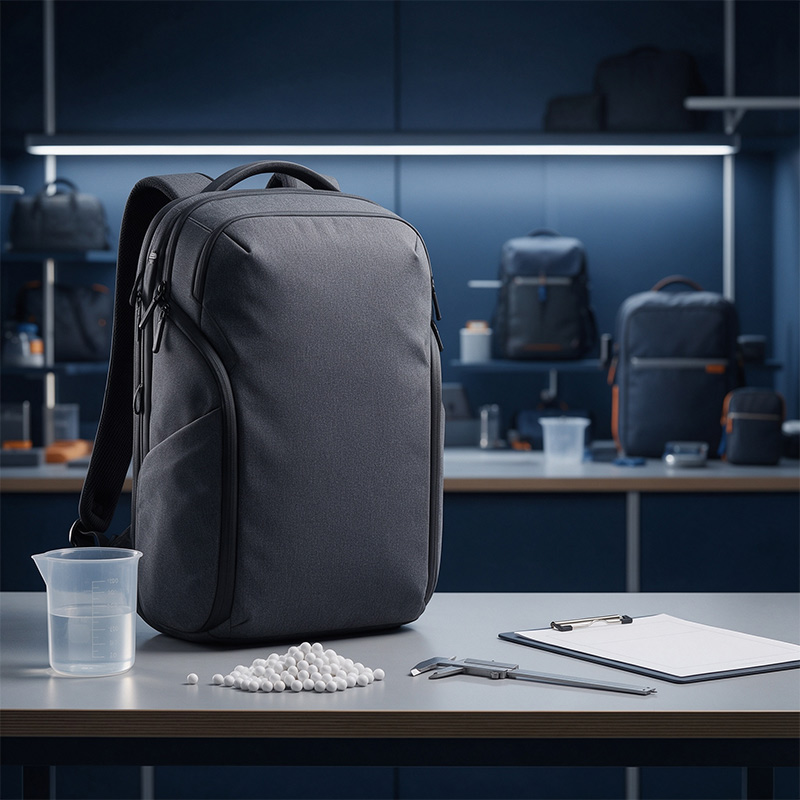
There are two widely used methods for measuring backpack capacity: geometric volume estimation and the ASTM F2153 fill test. During the design stage, the geometric formula (internal length × width × depth ÷ 1,000, multiplied by a pattern correction factor when necessary) can be used to estimate the maximum capacity. For sample approval and production capacity labeling, the unexpanded capacity measured using the ASTM F2153 fill test is generally used as the baseline. Geometric estimation is best suited to structured bags with regular shapes for preliminary space planning. Applying this method directly to sewn backpacks usually overestimates capacity. The fill test uses rigid plastic spheres with a diameter of 20 mm to fill all enclosed compartments; the spheres are then transferred to a calibrated measuring container to determine volume. The result can be used in purchase contracts, technical packs, inspection criteria, and product capacity labeling. For custom bag manufacturing, specifying the measurement method, included compartments, and tolerance alongside the capacity value helps align acceptance criteria between buyers and suppliers. Table of Contents Ⅰ. Why Backpacks with the Same Labeled Capacity Can Have Different Actual Volumes Ⅱ. Geometric Formula Estimation Ⅲ. ASTM F2153 Fill Test Ⅳ. Practical Recommendations for Backpack OEM Projects Ⅴ. Frequently Asked Questions (FAQ) Ⅵ. Conclusion Ⅰ. Why Backpacks with the Same Labeled Capacity Can Have Different Actual Volumes 1. Backpack Capacity Has No Globally Uniform Mandatory Labeling Standard Unlike shoe sizing or fabric weight, backpack capacity is not subject to a globally uniform mandatory labeling rule. Products labeled as 30 L may be measured using four common methods in the industry, producing different usable-volume results. Measurement method What is measured Typical result Notes Multiply external dimensions External length × width × height of the bag Likely to be overstated Counts fabric, foam, and back-panel structures as volume; unsuitable for labeled capacity. Main compartment only Largest enclosed main-compartment space Conservative Perceived usable space may exceed the labeled value, but the scope is limited and comparisons are less meaningful. Add all enclosed pockets Main compartment, zippered pockets, and covered enclosed pockets More comparable Closer to the logic of ASTM F2153; agree in advance whether open pockets are included. Promote expanded capacity Capacity with the roll-top or expansion zipper fully opened Represents maximum expanded state only Volume is lower in the normally closed state; some expanded bags may exceed airline carry-on limits. 2. Main Reasons for Differences in the Same Labeled Capacity For a daypack labeled 30 L, an external-dimension calculation includes space occupied by the back panel and shoulder-strap structure. Under the ASTM F2153 fill test, only enclosed compartments are counted; mesh water-bottle pockets and open front stash pockets are excluded. As a result, the unexpanded measured capacity may be only 24–25 L. Such differences are usually not manufacturing defects. They primarily result from different measurement methods and boundaries for what is included. 3. Capacity Must Be Matched to the Intended Use State Capacity can be reported as unexpanded capacity and expanded capacity. Unexpanded capacity refers to the bag in its normally closed, everyday-use configuration. Expanded capacity is the maximum volume available when a roll-top is fully opened or an expansion zipper is completely unzipped. A specification sheet that lists only one capacity value does not clearly identify the intended use state and makes inspection decisions more difficult. For roll-top bags and bags with expansion zippers, also verify the fully loaded external dimensions to determine whether the bag meets carry-on baggage size limits. Ⅱ. Geometric Formula Estimation 1. Basic Formula and Units A general geometric formula used in backpack OEM development is: Capacity (L) = Internal Length (cm) × Internal Width (cm) × Internal Depth (cm) ÷ 1,000 Example: With internal dimensions of 50 × 30 × 20 cm, the theoretical capacity is 50 × 30 × 20 ÷ 1,000 = 30 L. The formula uses centimeters and returns liters, based on 1 L = 1,000 cm³. For the North American market, capacity may also be listed in cubic inches; 1 L ≈ 61.024 cu in. 2. Appropriate Uses of the Geometric Formula • Reverse-engineering target dimensions during concept design: allocate internal usable dimensions based on the target capacity to support pattern and construction development. • Quickly estimating a capacity range during initial inquiries: when no physical sample is available, use external dimensions to make a preliminary assessment of the product category and support quotation and process evaluation. • Planning internal space before sampling: allocate space among the main compartment, laptop compartment, and front pockets, using the result as a theoretical upper-limit reference. 3. Why the Geometric Formula Can Be Inaccurate for Sewn Backpacks • The bag is not a perfect rectangular prism: daypacks that taper toward the top, roll-top bags, flap-top bags, and packs with curved suspension profiles have irregular shapes that cannot be accurately represented by a rectangular prism. • Fabric, foam, and suspension components reduce usable volume: laptop sleeves, back panels, and shoulder-strap anchor structures occupy space within the bag’s external profile. • Pocket-counting rules vary: external-dimension calculations may include side and front pockets, whereas standard fill testing counts enclosed compartments only and excludes open mesh pockets. • Seam allowances and lining thickness reduce usable space: sewing allowances, lining, and reinforcement materials reduce the effective internal volume. Conclusion: The geometric formula is a design-screening tool for estimating theoretical maximum volume; it should not be used directly as the labeled capacity of a sewn backpack. Results are more accurate for rectangular tote bags and simple travel duffels. For backpacks, technical outdoor packs, and styles with multiple complex compartments, capacity acceptance should be based on a fill test. 4. Early-Stage Estimation Before Sampling: Pattern Correction Factors During early development, before a physical sample is available, a pattern correction factor can help narrow the gap between theoretical and measured capacity. The adjusted formula is: Estimated capacity (L) ≈ [Internal length × internal width × internal depth (cm) ÷ 1,000] × K Select K according to the regularity of the bag’s shape. The ranges below are based on pattern databases and industry experience and are for design estimates only—not for official capacity labeling. The estimate must ultimately be calibrated against an ASTM fill test. Bag construction Reference correction factor Notes Boxy business backpack 0.80–0.85 Regular shape with high space efficiency. Standard daypack 0.75–0.80 Slightly contoured shape and space occupied by compartments. Outdoor hiking pack (internal aluminum-frame back panel) 0.70–0.75 Suspension system takes up more internal volume. Cylindrical duffel 0.72–0.78 Curved side walls reduce usable volume. Roll-top backpack 0.65–0.75 The rolled closure section is excluded from effective capacity. Tapered daypack, narrower at the top 0.70–0.78 The tapered cross-section makes the upper space less efficient. Example: A standard daypack with internal dimensions of 45 × 30 × 18 cm has a theoretical volume of 24.3 L. Using a correction factor of 0.78 gives an estimated capacity of approximately 19 L; subsequent fill testing will generally yield around 18–20 L. Important limitation: Correction factors are not universally transferable across factories or patterns. If the fabric weight or lining construction changes, re-test the bag and recalibrate K. In external technical communications, label this figure as a “design estimate,” not the contractual labeled capacity. Ⅲ. ASTM F2153 Fill Test 1. Standard Overview and Scope A commonly used industry standard for backpack capacity testing is ASTM F2153, “Standard Test Method for Measurement of Backpack Capacity.” It is a voluntary test method intended to establish consistent, comparable capacity-measurement rules among brands, factories, and inspection teams. Key principles: report both unexpanded and expanded capacity; count enclosed compartments only; exclude open mesh water-bottle pockets, open front stash pockets, and open compression pockets. The standard generally does not apply to small bags under 4 L. Crossbody mini bags, waist packs, and small organizers do not need to be labeled in liters; if a capacity value is provided, identify the alternative simplified test method used. 2. Standard Filling and Volume-Reading Procedure Step Procedure Control point 1. Prepare the test media Use uniform rigid plastic spheres with a diameter of 20 mm, commonly PP or PS. Foam beads and beans are for rough internal checks only; they compress or settle and have poor repeatability. Do not use them for official capacity labeling. 2. Fill all enclosed compartments Fill the main compartment and every zippered pocket. For roll-top bags, fill to the agreed number of rolls while ensuring normal closure. Close zippers after filling without pulling them taut. Do not omit any enclosed compartment. Exclude all open pockets. 3. Use a consistent settling procedure Gently shake the bag so the spheres settle naturally. A common procedure is three gentle shakes, approximately 10 seconds each. Do not deliberately press or compress the bag to inflate the reading. 4. Transfer the spheres to a calibrated measuring container Transfer all spheres into a graduated container calibrated by water-volume measurement. Gently agitate until the spheres settle, then record the volume. Large backpacks may be measured in multiple batches and the readings added together. Calibrate measuring equipment with water periodically and retain calibration records. 5. Repeat the test and average the results Conduct at least two independent tests. If the results differ by more than 1–2 L, filling or settling procedures may not have been consistent; repeat the test. Use the same spheres and measuring equipment for first-piece, in-line, and final inspections. 3. Limitations of the Standard and Its Relationship to Specification Sheets ASTM F2153 is voluntary and is not legally mandatory. Many retail product listings also omit the test method. The value of the test is that it allows the fill media, measuring equipment, included compartments, and tolerances to be defined in the specification sheet. If only a capacity number is listed without test details, results from different stages cannot be reliably compared. 4. When Full Laboratory Equipment Is Unavailable: Simplified Measurement Methods Not every inspection site has enough standard plastic spheres and calibrated measuring containers. A simplified method may be used during sampling, but the specification sheet must state that it differs from ASTM F2153. Scenario Simplified method Notes Compartments of 4 L or more Fill with 20 mm plastic spheres or uniform dry beans, then measure using a 1 L measuring cup and add the readings. Beans are for internal reference only; rigid plastic spheres are preferred for official capacity labeling. Compartments under 4 L Because small spheres stack with greater error, weigh the filling material first and convert to volume using a defined ratio if necessary. State in the documentation: “Not the ASTM F2153 standard procedure.” Curved or tapered bags Fill in vertical sections and add the readings from each section. A single rectangular-prism calculation will overestimate the capacity of tapered bags. Backpacks with multiple compartments Fill and measure each enclosed compartment separately, then total the results; list open pockets separately as excluded. Keep separate records to avoid confusion over what is included. Important: Capacity values obtained using different measurement methods should not be compared directly. Ⅳ. Practical Recommendations for Backpack OEM Projects 1. Recommended Capacity Fields for Specification Sheets To reduce the risk of a finished product’s capacity differing from expectations, include the following six items in the capacity section of the specification sheet: Field Recommended wording Purpose Measurement method “ASTM F2153 fill test using 20 mm PP spheres” / “Calculated from external dimensions; design reference only.” Identifies the method used to determine capacity. Unexpanded capacity Capacity in liters in the normally closed state. Matches typical use and product labeling. Expanded capacity Capacity in liters with the expansion zipper fully open or the roll-top fully unrolled. Distinguishes maximum expanded volume. Compartments included “Includes the main compartment and all zippered pockets; excludes mesh water-bottle pockets and open front stash pockets.” Removes ambiguity about which pockets count. Units List L and cu in together and specify the conversion. Supports reading preferences in different Western markets. Tolerance Agree on a tolerance by capacity range; use the same test method when judging compliance. Sets a reasonable acceptance range for inspection. 2. Example Wording for a Specification Sheet Capacity: 28 L unexpanded (approx. 1,709 cu in) / 34 L expanded (approx. 2,075 cu in), measured using the ASTM F2153 fill test with 20 mm PP plastic spheres. Includes the main compartment and all zippered pockets; excludes mesh water-bottle pockets and open front stash pockets. Tolerance: ±1.5 L. File the test record with the initial sample approval documents. 3. Suggested Tolerances and Contract Language Capacity range Suggested tolerance Application notes Under 20 L ±1 L Small bags are sensitive to compartment and opening design; test conditions must be controlled. 20–40 L ±1.5–2 L Common range for daypacks and commuter laptop backpacks. Over 40 L / large travel bags ±2–3 L Fill-test variation may be greater for large bags; additional repeats are recommended. Retail products with strict controls ±3%, or agree that “labeled capacity must not exceed measured unexpanded capacity.” Suitable for tightly controlled cross-border retail programs. Note: Tolerance criteria must correspond to the capacity test method. A tolerance established using external dimensions cannot be used to judge results from a fill test. 4. Common Capacity-Related Discrepancies in Custom Backpack Development Type of discrepancy Explanation Control measure Including open pockets in labeled capacity The counting method differs from ASTM and can produce inconsistent figures. Clearly list included and excluded pockets in the specification sheet. Advertising only expanded capacity Does not reflect volume in the product’s normally closed state. Provide both unexpanded and expanded capacity. Using external dimensions directly for sewn backpacks Foam, back panels, and lining take up space, so the calculated value is high. Use fill testing as the basis for labeled capacity; use external dimensions only as a supplementary reference. Using one capacity value for all sizes of a style Pattern and suspension structures change by size, affecting volume. Test each size independently. Testing only the first sample, with no production recheck Pattern adjustments, lining changes, and pocket revisions can change capacity. Test the approved reference sample and production trial units. Mixing metric and imperial units without labels Can lead to misinterpretation of readings. List both L and cu in in technical documents, with the primary unit suited to the target market. 5. Key Points When Comparing Multiple Samples Two products labeled with the same capacity may not perform equally in actual loading. Compare external dimensions, the main compartment’s internal usable dimensions, opening design, and photos of the bag when loaded. Even when both are labeled 30 L, a boxy pack and a tapered pack may accommodate different shapes of items. For travel backpacks and school backpacks, capacity is only one consideration. Flap-top designs are better suited to flat items, while top-loading roll-top bags offer good compression but can make items deep inside the bag harder to access. For a more complete assessment, include capacity, main-compartment internal dimensions, opening type, and fully loaded external dimensions in the specification sheet. 6. When to Conduct Capacity Tests Lock in the capacity baseline during initial sample approval. Once the first sample is complete, test capacity using the agreed method. After the parameters are approved, record them in the technical pack and purchasing documents before starting mass production. During inspection, use the same sphere specifications, measuring equipment, and settling procedure as for the approved sample, and assess the results against the agreed tolerance. 7. Capacity Records and Compliance Documentation Capacity testing is a technical specification activity and is separate from chemical testing of materials. Nevertheless, related records should be archived together for easy reference. If a product is labeled as using recycled fabric, the material claims should align with applicable GRS, GOTS, or OEKO-TEX documentation. Children’s backpacks sold in the United States must also meet applicable CPSIA requirements. A substantial discrepancy between labeled and measured capacity may create a risk of misleading advertising in the US and European markets. Store capacity test records and compliance certificates in the technical pack so they can be retrieved for customer factory audits and marketplace reviews. Ⅴ. Frequently Asked Questions (FAQ) Q1: Is backpack capacity accurately measured by multiplying length × width × height and dividing by 1,000? This formula estimates only the theoretical upper limit. It counts fabric, foam, and back-panel structures as volume and therefore generally overestimates usable space in sewn backpacks. The discrepancy is smaller for rectangular tote bags and simple travel duffels. For backpacks, outdoor packs, and styles with multiple compartments, capacity acceptance should be based on the ASTM F2153 fill test. A pattern correction factor can support early sampling estimates, but the result is for internal reference only and must not be used as the official labeled capacity. Q2: What is ASTM F2153? Are factories required to use it? ASTM F2153 is a voluntary test method for measuring backpack capacity; it is not legally mandatory. The core procedure is to fill all enclosed compartments with 20 mm rigid plastic spheres, transfer the spheres to a calibrated measuring container, and record both unexpanded and expanded capacity. Open water-bottle pockets and open stash pockets are excluded. The buyer and supplier should agree on whether to use the method in the technical documentation; once agreed, it becomes the basis for acceptance. Q3: Why does a factory label a backpack as 30 L when the fill-test result is only 25 L? This is usually due to differences in measurement methods—for example, using external dimensions or including open pockets in the calculation. A difference of around 20% between a daypack’s labeled capacity and its ASTM fill-test result is not unusual in the industry. Buyers and suppliers can establish a consistent basis for acceptance by agreeing in advance on the test method, pocket-inclusion rules, and tolerance range in the specification sheet. Q4: How should tolerances be set in a specification sheet, and which units should be used? For bags under 20 L, a tolerance of ±1 L is suggested; for 20–40 L, ±1.5–2 L; and for large bags over 40 L, ±2–3 L. For tightly controlled retail programs, the tolerance can be narrowed to ±3%, or the parties can agree that “the labeled capacity must not exceed the measured unexpanded capacity.” Use cubic inches (cu in) alongside liters for North America, while liters are generally preferred in Europe. Conversion: 1 L ≈ 61.024 cu in. Q5: How should capacity be tested for small bags under 4 L, waist packs, and organizers? ASTM F2153 generally does not apply to bags under 4 L. A simplified method can use a calibrated measuring cup, uniform dry beans, or a weight-to-volume conversion. The specification sheet must state that the method is “not the ASTM F2153 standard procedure.” Small spheres can stack inconsistently in small compartments, so external capacity claims for small bags should be made cautiously. Q6: Can rice or beans replace standard plastic spheres? They may be used for rough internal checks, but capacity figures used in contracts, specification sheets, or product labeling should not be based on rice or beans. Grains settle under pressure, and results vary between operators and batches, making repeatability poor. For formal testing, use 20 mm rigid PP/PS spheres and calibrated measuring equipment. Q7: For a roll-top backpack, how many rolls count as the unexpanded state under ASTM F2153? ASTM F2153 does not mandate a specific number of roll-top folds, which can lead to disagreement for this style. The buyer and supplier should agree in writing in the technical pack on the number of folds used for normal closure (commonly 2–3 rolls in the industry). Fill the bag to the agreed number of rolls and confirm that it closes normally without fabric tension; record this as the unexpanded capacity. The reading with the roll-top fully unrolled is the expanded capacity. Ⅵ. Conclusion From using geometric estimates to support early pattern planning, to determining labeled capacity through ASTM F2153 fill testing, and then specifying the test method, included compartments, and tolerances in clear technical terms, a verifiable capacity-assessment system is central to bag capacity management. Consistent criteria help project stakeholders avoid misunderstandings about specifications. As a professional bag manufacturer, we can support capacity-related technical requirements and help align project specifications with the agreed standards. Please contact us if you need assistance. Author
MEHR ANZEIGEN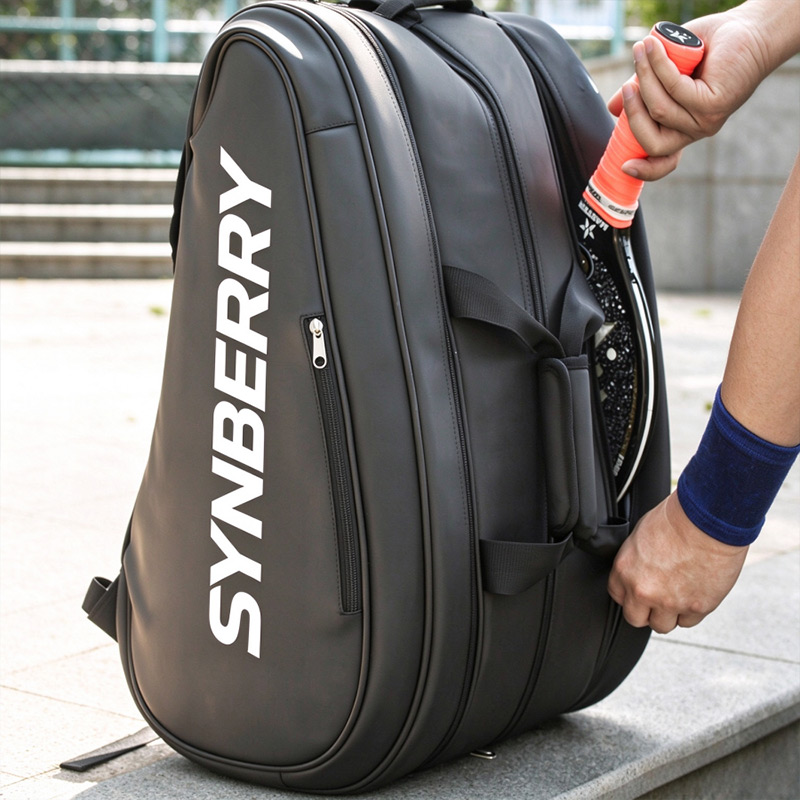
Eine hochwertige Pickleball-Tasche sollte vier Kernkriterien erfüllen: eine durchdachte Fächeraufteilung, ein komfortables Tragesystem, erstklassige Verarbeitung und strapazierfähige, wasserabweisende Materialien. Nur wenn alle vier Elemente vereint sind, kann eine Pickleball-Tasche wirklich als gut gelten.Inhaltsverzeichnis:Wissenschaftliche KammerkonstruktionKomfortables TragesystemHochwertige HandwerkskunstStrapazierfähige, wasserabweisende MaterialienAnpassungsempfehlungen für MarkenHäufig gestellte Fragen zur individuellen Gestaltung von Pickleball-TaschenAbschluss 1. Wissenschaftliche KammergestaltungDie Schlagflächen von Pickleball-Schlägern bestehen hauptsächlich aus Kohlefaser- oder Glasfaserverbundwerkstoffen, die empfindlich auf Druck, Kratzer und längere Einwirkung hoher Temperaturen und direkter Sonneneinstrahlung reagieren. Daher ist ein separates Schlägerfach ein unverzichtbares Merkmal einer guten Pickleball-Tasche.Ein hervorragendes Paddelfach sollte insbesondere folgende Merkmale aufweisen:Verdicktes, isoliertes Paddelfach: Das separate Paddelfach sollte über eine verdickte EVA- oder Perlwatte-Polsterschicht verfügen, um Stöße beim Fallenlassen oder Zusammendrücken der Tasche abzufedern. Darüber hinaus eine wärmeisolierende Auskleidung aus Aluminiumfolie kann hohen Außentemperaturen wirksam widerstehen und dazu beitragen, Verformungen der Paddeloberfläche durch längere Einwirkung direkter Sonneneinstrahlung zu verhindern.Großes Hauptfach: Das Hauptfach sollte ausreichend Platz bieten, um die gesamte Ausrüstung aufzunehmen, die für das tägliche Training oder Wettkämpfe benötigt wird, wie z. B. Kleidung, Handtücher, Wasserflaschen und andere Gegenstände.Schnellzugriff-Balltasche: Ein separates Netz- oder Gummifach im Hauptfach bietet Platz für Pickleballs. Diese separate Tasche hält die Bälle von der Kleidung getrennt und sorgt so für Ordnung und Sauberkeit der Ausrüstung. Spieler haben außerdem während des Aufwärmens oder zwischen den Spielen schnell Zugriff auf Ersatzbälle, ohne das gesamte Hauptfach durchsuchen zu müssen. Das verbessert die Effizienz und das Spielerlebnis.Separates, belüftetes Schuhfach: Durch die Trennung vom Hauptfach verhindert es, dass nasse oder schmutzige Schuhe Schläger und Kleidung verunreinigen und trägt gleichzeitig zur Reduzierung unangenehmer Gerüche bei. Dies ist ein entscheidendes Merkmal, das eine professionelle Pickleball-Tasche von einer gewöhnlichen Sporttasche unterscheidet.Mehrere kleine Taschen: Zur Aufbewahrung von persönlichen Gegenständen und Zubehör wie Mobiltelefonen, Schlüsseln, Griffen, Schutzausrüstung und Handtüchern.Verstecktes Wertsachenfach: Verfügt über ein weiches, mit Wildleder gefüttertes Innenfach zur sicheren Aufbewahrung von Wertsachen, die kratzempfindlich sind. 2. Komfortables TragesystemPickleball-Taschen gibt es üblicherweise in drei Tragevarianten: Rucksäcke, Schulter-/Umhängetaschen und wandelbare Taschen, die entweder in der Hand oder als Rucksack getragen werden können. Rucksack: Ideal für den Transport mehrerer Paddel und einer kompletten Ausrüstung. Seine wichtigsten Merkmale liegen im Design der Schultergurte und des Rückenteils. Die Schultergurte eines hochwertigen Rucksacks sollten breit und dick sein, mit hochdichtem Schaumstoff gepolstert und mit atmungsaktivem Netzgewebe überzogen sein. Dies verteilt den Druck gleichmäßig auf die Schultern, fördert die Luftzirkulation und verhindert so übermäßige Wärmeentwicklung und Druckstellen bei längerem Tragen. Das Rückenteil sollte über eine Stützschicht aus EVA oder PE-Perlbaumwolle verfügen, um Verformungen oder ein Zusammenfallen unter schwerer Last zu verhindern. Es sollte sich zudem der natürlichen Krümmung der Wirbelsäule anpassen und so stabilen und zuverlässigen Halt bieten.Schultertaschen oder Umhängetaschen: Diese Taschen zeichnen sich durch geringes Gewicht, hohen Tragekomfort und Flexibilität aus und eignen sich daher ideal für kurze Trainingseinheiten oder Situationen, in denen nur wenig Ausrüstung benötigt wird. Der Schultergurt sollte breit genug sein, um ein Verrutschen zu verhindern, und das Schulterpolster sollte über eine Polsterung verfügen, um die Belastung beim Tragen von Gewicht auf einer Schulter zu reduzieren. Dank des verstellbaren Schultergurts findet jeder Träger, unabhängig von seiner Körpergröße, die optimale Passform.Wandelbare Tragetasche und Rucksack: Für alle, die Wert auf Vielseitigkeit legen, bietet eine wandelbare Tragetasche und ein Rucksack maximale Flexibilität. Diese Taschenart verfügt typischerweise über einen verstärkten Tragegriff für bequemes Tragen über kurze Strecken oder zum Verstauen im Auto sowie einen gepolsterten Seitengriff, der den Druck auf die Hand reduziert und Beschwerden beim Tragen vorbeugt.Im Rucksackmodus lassen sich die verdeckten Schultergurte leicht herausziehen und sicher befestigen, um in beiden Konfigurationen ein komfortables Tragegefühl zu gewährleisten. Unabhängig vom gewählten Tragestil ist das oberste Ziel des Tragesystems, dass sich die Spieler auf dem Weg zum und vom Platz wohlfühlen. 3. Hochwertige VerarbeitungDie Details der Verarbeitung bestimmen direkt die Lebensdauer sowie das Aussehen und die Haptik einer Pickleball-Tasche.Nähte: Die Nähte müssen robust und haltbar sein, mit gleichmäßigem Stichabstand und sauberen, gleichmäßigen Nähten. Besonders beanspruchte Stellen, wie z. B. die Befestigungspunkte der Schultergurte, die Griffansätze und die Enden des Reißverschlusses, sollten durch Doppel- oder sogar Dreifachnähte verstärkt werden. Riegel Verstärkungen zur Verbesserung der Reißfestigkeit und zur Verhinderung des Aufreißens oder Brechens der Nähte unter anhaltender schwerer Belastung.Die Wahl der Beschläge ist entscheidend. Reißverschlüsse sollten leichtgängig, robust und wasserabweisend sein, idealerweise von renommierten Marken wie YKK oder SBS. Die Zipper sollten so gestaltet sein, dass sie sich auch mit Sporthandschuhen gut greifen und bedienen lassen.Schnallen: Die Schnallen sollten einem Dauerfestigkeitstest unterzogen werden, um sicherzustellen, dass sie auch nach wiederholtem Öffnen und Schließen nicht reißen oder sich verformen. Darüber hinaus sollten die Stoffkanten sauber verarbeitet sein, ohne lose Fäden, und die Tasche sollte auch im leeren Zustand formstabil und formstabil bleiben und nicht leicht zusammenfallen. Diese Details zeugen von professioneller Qualität und Liebe zum Detail. 4. Strapazierfähige, wasserabweisende MaterialienPickleball wird oft im Freien gespielt, wo die Taschen plötzlichen Regenschauern oder Morgentau auf dem Platz ausgesetzt sein können. Daher dient die Wasserbeständigkeit des Materials als erste Schutzbarriere für die Ausrüstung im Inneren. 4.1 Hauptmaterial: Nylon vs. PolyesterEine hochwertige Pickleball-Tasche sollte aus hochdichtem Nylon (z. B. 600D oder höher) oder Polyestergewebe gefertigt sein. Diese Materialien bieten hervorragende Abrieb- und Reißfestigkeit sowie gute wasserabweisende Eigenschaften.Nylon: Im Vergleich dieser beiden gängigen Materialien zeichnet sich Nylon durch sein besseres Verhältnis von Festigkeit zu Gewicht und seine hervorragende Abriebfestigkeit aus und ist daher die bevorzugte Wahl für hochwertige Pickleball-Taschen. Es hat eine glatte Oberfläche und fühlt sich weich an, ist aber vergleichsweise teurer.Polyester: Polyester bietet eine bessere UV-Beständigkeit und Farbbeständigkeit und ist daher weniger anfällig für Ausbleichen oder Materialermüdung nach längerer direkter Sonneneinstrahlung. Es ist zudem preisgünstiger und somit eine kostengünstige Wahl. 4.2 Wasserdichte BeschichtungenEin hochwertiges Basismaterial allein reicht nicht aus, um extremen Wetterbedingungen standzuhalten. Die Oberflächenimprägnierung ist der entscheidende Faktor für die wasserabweisenden Eigenschaften einer Tasche. Die meisten professionellen Pickleball-Taschen auf dem heutigen Markt verwenden eine der drei Hauptbehandlungen: DWR-Beschichtung (Durable Water Repellent), PU-Beschichtung oder TPU-Beschichtung.DWR-Wasserabweisende Beschichtung: Die DWR-Beschichtung erzeugt einen Lotusblatt-Effekt auf der Oberfläche der Tasche. Dadurch perlen Wassertropfen ab und rollen schnell ab, anstatt in das Gewebe einzudringen. Dies verhindert effektiv, dass Regenwasser die Ausrüstung im Inneren durchnässt.PU-Wasserabweisende Beschichtung: Die PU-Beschichtung wird üblicherweise auf die Innenseite des Gewebes aufgetragen und bildet eine dichte, wasserdichte Membran. Sie verhindert nicht nur das Eindringen von Feuchtigkeit von außen, sondern verbessert auch die Gesamtstruktur des Gewebes und seine Reißfestigkeit.TPU-Wasserdichte Beschichtung: Als thermoplastisches Polyurethan-Elastomer wird die TPU-Beschichtung üblicherweise als dünne Schicht auf die Innenseite des Gewebes laminiert oder als separate Schicht eingearbeitet. Im Vergleich zu PU-Beschichtungen bietet TPU eine überlegene Hydrolysebeständigkeit und Flexibilität bei niedrigen Temperaturen. Selbst in kalter und feuchter Umgebung ist sie weniger anfällig für Zersetzung, Aushärtung oder Rissbildung und trägt so dazu bei, die Wasserdichtigkeit der Tasche langfristig zu erhalten. 5. Empfehlungen zur Personalisierung für MarkenWenn Sie planen, eine Pickleball-Tasche unter Ihrer eigenen Marke zu entwickeln, können Ihnen die folgenden Empfehlungen in drei Schlüsselbereichen dabei helfen, das richtige Gleichgewicht zwischen Produktleistung, Kosten und Zielgruppe zu finden. 5.1 Empfehlungen zur Auswahl des HauptstoffsDas Material bestimmt Aussehen, Haptik, Haltbarkeit und Preispotenzial einer Pickleball-Tasche. Die folgende Tabelle enthält Empfehlungen zur Materialauswahl basierend auf der Produktpositionierung.StoffoptionAllgemeine SpezifikationenFestigkeit / AbriebfestigkeitUV-BeständigkeitKostenEmpfohlene PositionierungPolyester600D / 900D★★★☆★★★★☆ (lichtecht)MäßigPreisgünstige Modelle, Einsteigermodelle und Produkte für längere Sonneneinstrahlung im FreienNylon600D / 1680D ballistisches Nylon★★★★★ (robust und leicht)★★★ (UV-Behandlung empfohlen)Mittel bis hochMittel- bis hochpreisige Modelle und Taschen für professionelle SpielerNylon + Ripstop / JacquardKariertes Nylon, Wabenstruktur★★★★★★★★HochPremiummodelle und DesignermarkenVerbundgewebe (PVC/EVA)500D–1000D★★★★☆★★★☆MäßigVerbesserte wasserdichte Modelle und Taschen für den Strand oder den MehrzweckeinsatzWichtige Auswahlkriterien:Bei Modellen mit hohem Absatzvolumen sollte 600D-Polyester bevorzugt werden. Es bietet überschaubare Kosten und eine gute Farbechtheit und ist daher eine beliebte Wahl für gängige Einsteigerprodukte.Für Modelle im mittleren bis gehobenen Preissegment empfiehlt sich ballistisches Nylon aus 1000D oder 1680D. Dank seiner hohen Festigkeit und guten Wasserbeständigkeit eignet es sich für diesen Markt.Umweltfreundliche Alternativen: Ziehen Sie recyceltes Nylon, wie z. B. ECONYL®, oder recyceltes Polyester (RPET) in Betracht und unterstützen Sie international anerkannte Zertifizierungen wie GRS, um der wachsenden Nachfrage nach nachhaltigen Produkten auf den europäischen und nordamerikanischen Märkten gerecht zu werden. 5.2 Empfehlungen zur KapazitätsauswahlGrößer ist nicht immer besser, wenn es um die Kapazität geht. Die ideale Größe sollte den Spielsituationen und Tragegewohnheiten der Zielgruppe entsprechen. Die folgende Tabelle enthält Empfehlungen zur Kapazitätsgestaltung für die Entwicklung von Pickleball-Taschen für OEMs.KapazitätskategoriePaddelkapazitätTypische KonfigurationZielgruppeReferenzabmessungen (L × B × H)Leichtes Modell1–2 PaddelHauptfach + Balltasche + Flaschenhalter; normalerweise kein SchuhfachGelegenheitsspieler und Leute, die Spazierengehen mit Pickleball verbindenCa. 45 × 20 × 25 cmStandardmodell (empfohlen)2–4 PaddelGepolstertes Schlägerfach + Hauptfach + separates Schuhfach + Balltasche + Fächer für KleinteileKernmitglieder des Vereins und regelmäßige DoppelspielerCa. 50 × 25 × 32 cmProfessionelles Modell mit großer Kapazität4–6 PaddelGepolstertes Paddelfach + großes Hauptfach + separates Schuhfach + Balltasche + wasserdichte TascheProfispieler und TrainerCa. 55 × 30 × 38 cmReise-/Teammodell6 oder mehr PaddelRollkofferartige Tasche oder extra großer Rucksack mit externen BefestigungssystemenTeam-Großeinkäufe und Spieler, die häufig reisenCa. 60 × 35 × 45 cmWichtige Auswahlkriterien:Das Standardmodell ist optimal. Eine Tasche für 2–4 Schläger eignet sich für eine breite Spielergruppe. Marken, die eine neue Pickleball-Taschenlinie entwickeln, sollten diese Kapazität als Hauptprodukt in Betracht ziehen.Leichte Modelle eignen sich ideal zur Kundengewinnung oder als Werbegeschenke. Dank ihrer einfachen Konstruktion und des geringeren Preises sind sie perfekt als Ergänzungstaschen für Einsteigersets oder als Erinnerungsgeschenke für Vereinsveranstaltungen geeignet und senken so die Einstiegshürde für neue Spieler.Professionelle Modelle mit großem Fassungsvermögen sollten den Fokus auf effiziente Aufbewahrung legen, anstatt einfach nur mehr Platz zu bieten. Um die Herausforderung der Organisation der umfangreichen Ausrüstung von Trainern und Profispielern zu meistern, bieten sich herausnehmbare Trennwände oder modulare Innenfächer an. Diese ermöglichen es den Nutzern, verschiedene Kombinationen von Schlägern und Kleidung unterzubringen und gleichzeitig für Ordnung im Inneren zu sorgen.Reise- und Teammodelle sollten reisefreundliche Eigenschaften in den Vordergrund stellen. Neben einem besonders großen Fassungsvermögen sollten sie über einen Standard-Gepäckgurt und abriebfeste Schutzfüße verfügen. Diese Merkmale helfen, die Pickleball-Tasche bei Flughafentransfers und längeren Reisen sicher am Koffer zu befestigen und gleichzeitig den Verschleiß am Taschenboden zu reduzieren. 6. FAQ: Häufig gestellte Fragen zur individuellen Gestaltung von Pickleball-Taschen Frage 1: Worin besteht der Unterschied zwischen einer Pickleball-Tasche und einer Tennistasche? Können sie gegeneinander ausgetauscht werden?Sie können zwar vorübergehend austauschbar verwendet werden, dies ist jedoch nicht empfehlenswert. Pickleball-Schläger (ca. 40 cm lang) sind kürzer als Tennisschläger, daher kann in Tennisschlägerfächern zu viel Leerraum entstehen, wodurch die Schläger verrutschen und mit anderen Gegenständen zusammenstoßen können. Pickleball-Taschen verfügen in der Regel über separate Ballfächer, da die harten Kunststoff-Picklebälle durch zu starken Druck beschädigt werden können, sowie über Schuhfächer und weitere Fächer für Kleinigkeiten. Wenn Sie ausschließlich Pickleball spielen, bietet eine spezielle Pickleball-Tasche einen deutlich höheren Komfort. Frage 2: Woran erkenne ich die Wasserdichtigkeit einer Tasche? Bedeutet wasserabweisend, dass sie wasserdicht ist?Nein. Eine DWR-Beschichtung bietet zwar in der Regel ausreichenden Schutz vor leichtem Regen und Spritzwasser, doch durch Reißverschlüsse kann weiterhin Wasser eindringen. Für einen umfassenderen Wasserdichtigkeitsschutz benötigt die Tasche eine Kombination aus PU/TPU-beschichtetem oder laminiertem wasserdichtem Gewebe und wasserdichten Reißverschlüssen, wie beispielsweise denen der wasserdichten Reißverschlussserie von YKK. Achten Sie beim Kauf darauf, ob in den Produktspezifikationen sowohl die Gewebebeschichtung als auch die wasserdichten Reißverschlüsse erwähnt werden. Frage 3: Warum benötigt das Fach eines Pickleball-Schlägers eine Wärmedämmung? Kann Sommerhitze einen Schläger tatsächlich beschädigen?Ja. Pickleball-Schläger mit Schlagflächen aus Kohlefaser oder Fiberglas und Polypropylen-Wabenkern können nach längerer Einwirkung hoher Temperaturen und direkter Sonneneinstrahlung eine Erweichung der Schlagfläche, Delamination oder Veränderungen des Spielgefühls aufweisen. Eine wärmeisolierende Aluminiumfolienauskleidung kann die Temperatur im Inneren der Tasche deutlich senken und ist daher eines der Hauptmerkmale, die eine professionelle Pickleball-Tasche von einem Budgetmodell unterscheiden. Frage 4: Wie hoch ist die übliche Mindestbestellmenge (MOQ) und Lieferzeit für individuell gestaltete Pickleball-Taschen?Die Standard-Mindestbestellmenge von SYNBERRY beträgt ca. 500 Stück. Die Lieferzeit für Muster hängt von der Komplexität des Designs ab und beträgt in der Regel 2–3 Wochen. Die Lieferzeit für die Serienproduktion variiert je nach Bestellmenge und Fertigungskomplexität. Für Sonderprozesse wie vollflächigen Druck, reflektierende Streifen und individuell geformte Schnallen sollte zusätzliche Zeit eingeplant werden. Frage 5: Sollte ich für eine Pickleball-Tasche Nylon oder Polyester wählen? Welches Material ist haltbarer?Beide Materialien sind strapazierfähig, bieten aber jeweils unterschiedliche Vorteile. Nylon ist robuster und fühlt sich angenehmer an, wodurch es sich für Produkte im mittleren bis gehobenen Preissegment eignet. Polyester bietet eine bessere UV-Beständigkeit, eine höhere Farbbeständigkeit und ist günstiger, was es ideal für kostengünstige Modelle macht, die für den längeren Einsatz im Freien in der Sonne vorgesehen sind. Wählen Sie Nylon, wenn Ihr Budget es zulässt; wählen Sie Polyester, wenn ein gutes Preis-Leistungs-Verhältnis Priorität hat. 7. SchlussfolgerungPickleball erfreut sich weltweit rasant wachsender Beliebtheit, und Pickleball-Taschen entwickeln sich von bloßem Zubehör zu einer spezialisierten Produktkategorie. Für Sporttaschenhersteller bietet dies nicht nur die Chance, in einen aufstrebenden Markt einzusteigen, sondern auch ein entscheidendes Zeitfenster, um durch verfeinerte Produktentwicklung eine professionelle Markenbekanntheit zu erlangen.Eine exzellente Pickleball-Tasche sollte mehr sein als nur eine Ansammlung von Fächern. Sie sollte ein tiefes Verständnis für die Bedürfnisse des Spielers widerspiegeln und dessen Erwartungen durchdacht erfüllen. Von der Wärmeisolierung zum Schutz teurer Schläger über eine optimierte Fächeraufteilung bis hin zu wetterfesten Materialien für den Einsatz im Freien – jedes Detail zeugt von Respekt vor dem sportlichen Erlebnis des Spielers.Dieser Artikel wurde aus der Perspektive eines Herstellers von Pickleball-Taschen verfasst und soll Marken, die Produktlinien für Pickleball-Taschen entwickeln, einen umfassenden Leitfaden bieten – von der Ermittlung der Kundenbedürfnisse bis hin zur Markteinführung der Produkte. Autor
MEHR ANZEIGEN
Die gängigsten Futterstoffe für Kosmetiktaschen sind Polyestergewebe, insbesondere Polyester-Leinwandbindung, Polyestertaft, Pongee und beschichtetes Polyester. Darüber hinaus werden Nylon, TPU, PEVA, PVC und EVA häufig für Produkte mit hohen Anforderungen an Wasserdichtigkeit und Auslaufsicherheit eingesetzt. Recyceltes Polyester (RPET) und recyceltes Nylon eignen sich für nachhaltige Markenlinien. Mikrofaser, Velourslederimitat, Samt und Satin zeichnen sich durch eine hochwertige Haptik und die Positionierung als Geschenk aus. Baumwolle, Canvas, Baumwoll-Polyester-Mischgewebe und Baumwoll-Leinen-Mischgewebe eignen sich ebenfalls als Futter für Kosmetiktaschen, insbesondere für Canvas-Kosmetiktaschen, Modelle im natürlichen Stil, umweltfreundliche Produkte oder solche, die eine Stickereistruktur erfordern. Ihre Eigenschaften hinsichtlich Wasserfestigkeit, Fleckenbeständigkeit und Pflegeleichtigkeit unterscheiden sich jedoch in der Regel von beschichteten Synthetikfasern und müssen je nach Anwendungsfall bewertet werden. Inhaltsverzeichnis:• Auswahl nach funktionalen Anforderungen• Wichtige technische Parameter für die Auswahl der Auskleidung• Prozesse zur Anpassung der Futterstoffe und Methoden zur Logopräsentation• Wie gewährleisten wir eine lückenlose Materialqualitätskontrolle für Marken?• Häufig gestellte Fragen• Abschluss I. Auswahl nach funktionalen Anforderungen und Analyse gängiger StoffeBei der Auswahl des Futters für Kosmetiktaschen spielen Fleckenbeständigkeit und Wasserdichtigkeit, Schutz der Kosmetika, einfache Reinigung sowie Formbeständigkeit und Stabilität eine zentrale Rolle. Im Folgenden werden die Materialien nach funktionalen Anforderungen kategorisiert und ihre Eigenschaften, Anwendungsbereiche und Vorsichtsmaßnahmen erläutert. 1. Wasserdichte und leicht zu reinigende Kategorie• PVC/TPU-Folie: Wird häufig für funktionelle Kosmetiktaschen und Nass-/Trocken-Trennfächer verwendet und zeichnet sich durch hervorragende Wasser- und Auslaufsicherheit aus. Verschüttete Flüssigkeiten lassen sich leicht abwischen. PVC bietet hervorragende Wasserdichtigkeit und Transparenz, jedoch müssen die Risiken hinsichtlich der Einhaltung der REACH- und Prop 65-Verordnung für den europäischen und amerikanischen Markt sorgfältig geprüft werden. TPU ist insgesamt umweltfreundlicher, UV-beständiger und flexibler und daher die bevorzugte Wahl für hochwertige, wasserdichte Modelle.• PEVA: Chlorfrei und somit eine umweltfreundliche Alternative zu PVC. Es bietet gute Wasserfestigkeit und lässt sich leicht abwischen – ideal für Marken mit Nachhaltigkeitsanforderungen. Längere UV-Strahlung kann zu einer leichten Vergilbung führen, die bei der Mustererstellung geprüft werden sollte.• EVA: Wird häufig für starre Innenschalen oder geformte Auskleidungen verwendet, bietet gute Wasserdichtigkeit und strukturelle Unterstützung und eignet sich für Kosmetiktaschen-Innenkerne, die Formbeständigkeit erfordern.• Beschichtetes Polyester und beschichtetes Oxford-Gewebe (z. B. PU- oder TPU-Beschichtung): Durch die Beschichtung von Polyester oder Oxford-Gewebe bildet sich ein durchgehender Film auf der Futteroberfläche, der das Eindringen von Flüssigkeiten wie flüssigem Make-up und Hautpflegeprodukten effektiv verhindert. Das Material ist abrieb- und reißfest, bietet ein gutes Preis-Leistungs-Verhältnis und eignet sich für preiswerte Kosmetiktaschen mit großem Fassungsvermögen und funktionale Alltagsbegleiter. Bitte beachten Sie, dass Beschichtungen und Nähte nicht absolut wasserdicht sind.• Polyester-Leinwandbindung, Pongee, Polyester-Taft: Stabile Verfügbarkeit, hohe Schneide- und Nähleistung sowie dauerhafte Farbechtheit gewährleisten eine gleichbleibende Futterfarbe über verschiedene Chargen hinweg bei Großbestellungen. Polyester-Taft ist leicht, hochdicht, glatt, reißfest und zeichnet sich durch sein geringes Gewicht aus. Pongee und Leinwandbindung eignen sich für Massenmarktmodelle. Für grundlegende Anforderungen an die Wasserdichtigkeit sind leicht beschichtete Varianten erhältlich.• Nylon-Taft: Angenehm weich im Griff, reißfester als Polyester gleicher Spezifikation, geeignet für Kosmetiktaschen im mittleren bis gehobenen Preissegment. Nylon besitzt wasserabweisende Eigenschaften und wird häufig für wasserdichte und leicht zu reinigende Futter verwendet. Wenn es bei dem Produkt auf geringes Gewicht, Langlebigkeit und Reisetauglichkeit ankommt, ist Nylon eine Überlegung wert.[Zusätzlicher Hinweis] Beschichtete Stoffe sind nur spritzwassergeschützt. Herkömmliche Nähte erzeugen Nadelstiche, durch die Flüssigkeiten dringen können. Für vollständige Dichtigkeit ist ein zusätzliches Heißsiegelverfahren erforderlich. 2. Kategorie Formbeständigkeit und Polsterung• Filz: Hohe Steifigkeit, starke Stützkraft, trägt zur Formstabilität der Kosmetiktasche bei und bietet eine gewisse Polsterung und Stoßdämpfung. Geeignet für maßgefertigte Innentaschen und Produkte, die Puderkompakte und Lidschattenpaletten schützen müssen. Gewicht, Reinigungsmethoden und Dicke sollten beachtet werden.• Fleece-Kategorie (z. B. Mikrofaser-Fleece, Velourslederimitat, Samt): Angenehm weich und leicht dämpfend, reduziert das Verrutschen und Verkratzen von Kosmetikflaschen und eignet sich für Kosmetiktaschen im mittleren bis gehobenen Preissegment. Mikrofaser, Velourslederimitat und Samt bieten ein hochwertiges haptisches Erlebnis und rutschfeste Eigenschaften und werden vorwiegend für hochwertige Markenprodukte verwendet.3. Hochwertige Texturkategorie• Acetat-Satin: Glatt und weich im Griff, warmer Glanz, guter Fall und Knitterfestigkeit, glatt zum Entnehmen und Einlegen von Kosmetika, verhakt sich nicht mit den Borsten des Make-up-Pinsels, geeignet für ein leichtes Luxus-Segment.• Gewöhnlicher Satin/Satin: Glatte Oberfläche, hautfreundlich, mit sanftem Glanz, verleiht edlen Oberflächen und eignet sich für Geschenke und Produkte, bei denen visuelles Design wichtig ist. Achten Sie auf Reißfestigkeit, Abriebfestigkeit und Farbechtheit. Polyester- und Nylonsatin bieten hervorragende Druckergebnisse und eignen sich für hochwertige Futterstoffe.4. Umweltfreundliche, recycelte und nachhaltige Kategorie• RPET: Hergestellt aus recycelten PET-Flaschen durch Zerkleinern, Reinigen und Verspinnen zu Garn. Haptik, Farbechtheit und Abriebfestigkeit unterscheiden sich kaum von neuem Polyester. Es kann herkömmliche Polyestergewebe oder Taft nahtlos ersetzen und eignet sich für die meisten gängigen Kosmetiktaschenfutter. Marken, die ESG-Konzepte verfolgen, verwenden dieses Material häufig.• Recyceltes Nylon: Es wird hauptsächlich aus ausrangierten Fischernetzen, Teppichfasern und anderen Industrieabfällen gewonnen und durch Depolymerisation und Polymerisation regeneriert. Im Vergleich zu RPET weist recyceltes Nylon eine höhere Festigkeit, Elastizität und Chemikalienbeständigkeit auf und fühlt sich feiner und glatter an. Allerdings ist die Marktverfügbarkeit weniger stabil und die Kosten sind in der Regel höher.5. Kategorie „Natürlicher Stil und Mischkosmetik“• Baumwolle: Natürliches Griffgefühl, hautfreundlich, feuchtigkeitsabsorbierend, geeignet für einen natürlichen Stil, umweltfreundliche Positionierung und als Futter für Kosmetiktaschen aus Canvas.• Canvas: Höheres Grammatur, gute Stabilität, strapazierfähig, geeignet für Kosmetiktaschen, Kulturbeutel, Reisetaschen (Innenfutter oder Außentaschen). Bei Verwendung als Futter müssen Gewicht, Dicke und Verarbeitung sorgfältig geprüft werden. Baumwoll-Canvas ist atmungsaktiv und leicht und eignet sich für Puderprodukte, Make-up-Pinsel und andere Artikel, die Belüftung benötigen.Gewöhnliche Baumwolle und Canvas sind nicht wasserdicht und nehmen leicht Farben und Flecken auf. Bei direktem Kontakt mit flüssigen Kosmetika ist die Reinigung schwierig. Eine gängige Lösung ist die Kombination mit herausnehmbaren, waschbaren Innentaschen, einer speziellen Beschichtung, separaten wasserdichten Beuteln oder einer durchdachten Innenaufteilung. • Baumwoll-Polyester-Mischung: Vereint das natürliche Griffgefühl von Baumwolle mit der Strapazierfähigkeit und Formstabilität von Polyester und eignet sich für Projekte, bei denen ein Gleichgewicht zwischen Textur und Serienfertigung erforderlich ist.• Baumwoll-Leinen-Mischung: Ausgeprägte natürliche Textur, geeignet für bestimmte Stilrichtungen, jedoch müssen Fleckenbeständigkeit und Farbechtheit während der Musterphase bestätigt werden.6. Weitere praktische Kategorien• PU-Beschichtung: Strukturiert, leicht abwischbar, geeignet für den täglichen Gebrauch und Produkte im mittleren Preissegment. Die dichte Oberfläche verhindert effektiv das Eindringen von ölhaltigen Flecken wie flüssigem Make-up und Lippenstift. Ein feuchtes Tuch genügt zur einfachen Reinigung, wodurch der Wartungsaufwand gering ist. Wichtig: Wählen Sie PU-Materialien mit guter Hydrolysebeständigkeit, um ein Abblättern oder Verkleben der Beschichtung nach längerem Gebrauch zu vermeiden, insbesondere in Umgebungen mit hohen Temperaturen und hoher Luftfeuchtigkeit, wo Alterungstests erforderlich sind.• Netzgewebe/Dreilagiges Netzgewebe: Hervorragende Atmungsaktivität, geringes Gewicht. Wird häufig für Innentaschen oder die Aufbewahrung von Pinseln in Kosmetiktaschen verwendet. Ermöglicht schnelles Auffinden von Artikeln und beschleunigt die Feuchtigkeitsabfuhr, wodurch das Risiko von Schimmelbildung reduziert wird. Aufgrund seiner unebenen Oberfläche und großen Poren sammelt sich jedoch leicht Schmutz an und es ist schwer gründlich zu reinigen. Es wird nicht empfohlen, es als Hauptfutter für den direkten Kontakt mit flüssigen Kosmetika zu verwenden und sollte üblicherweise mit einer wasserdichten Innentasche kombiniert werden.II. Wichtige technische Parameter für die Auswahl der AuskleidungBei der Auswahl von Futterstoffen für Kosmetiktaschen beeinflussen die folgenden Parameter die Endproduktqualität und die Benutzerfreundlichkeit unmittelbar. Es wird empfohlen, jeden einzelnen Punkt bereits in der Musterphase zu überprüfen. 1. Grammgewicht und Dicke• Geringes Grammgewicht (z. B. 30-50 g/m² Polyester-Taft oder Pongee): Leicht und weich, maximiert die Platzersparnis im Inneren, reduziert das Gesamtgewicht, geeignet für Reisekosmetiktaschen, die höchste Tragbarkeit und geringes Gewicht anstreben.• Mittleres Grammatur (z. B. 60–100 g/m² Polyester, Nylon oder Baumwolle in Leinwandbindung): Bietet ein ausgewogenes Verhältnis von Haptik und Strapazierfähigkeit und ist die gängigste Wahl für die meisten herkömmlichen Kosmetiktaschen. Stoffe dieser Kategorie sind mäßig steif, erhalten die Grundform der Tasche und bieten gleichzeitig gute Nähstabilität und Abriebfestigkeit. Sie eignen sich für den täglichen Gebrauch und vielseitige Aufbewahrungsmöglichkeiten.• Hohes Grammatur (z. B. dickes Canvas mit 120 g/m²+, verdicktes beschichtetes Gewebe oder Verbundfilz): Ausgezeichnete Steifigkeit und strukturelle Unterstützung, wodurch die dreidimensionale Form der Kosmetiktasche effektiv erhalten bleibt und eine Verformung durch Kompression des Inhalts verhindert wird; wird häufig für Hartschalen-Kosmetiktaschen oder Innenkonstruktionen verwendet, die selbstständig stehen müssen. 2. Beschichtungsart und WasserdichtigkeitBeschichtungsartWasserdichtigkeitAbriebfestigkeitUmweltfreundlichkeitTypische AnwendungPU-BeschichtungGutGutMediumKosmetiktaschen für den täglichen GebrauchTPU-VerbundwerkstoffExzellentExzellentExzellentHochwertige, wasserdichte ModellePEVAGutMediumGutUmweltfreundliche PositionierungsstilePVCExzellentGutDie Einhaltung der Vorschriften erfordert eine sorgfältige Bewertung.Transparente StileEVAGutGut MediumGeformte Innenschalen, starre Auskleidungen 3. Farbechtheit, Abriebfestigkeit und Farbauswahl• Die Futterstoffe müssen Trockenreib- und Nassreibechtheitstests bestehen und den Anforderungen des Zielmarktes und der Marke entsprechen (siehe ASTM/ISO-Industrieprüfnormen).• Bei der Farbauswahl müssen Markenvision, Nutzungsgewohnheiten der Zielgruppe, Reinigungs- und Wartungserwartungen sowie das Gesamtdesign berücksichtigt werden.• Dunkle oder mittlere Farbsysteme sind im täglichen Gebrauch in der Regel weniger anfällig für Flecken; helle Farbsysteme wirken frisch und passen zu einigen Markenfarben, können aber Kosmetikrückstände leichter zeigen, daher können Beschichtungen, pflegeleichte Ausrüstungen oder herausnehmbare, waschbare Innenbeutel kombiniert werden. 4. Bruchfestigkeit und Weiterreißfestigkeit• Die Bruchfestigkeit und Weiterreißfestigkeit des Futterstoffs müssen den branchenüblichen Prüfstandards, wie z. B. ASTM D5034, entsprechen.• Spezifische Indikatoren müssen mit der Produktpositionierung, den Anwendungsszenarien und den Qualitätsanforderungen der Marke übereinstimmen. 5. Haptik, Geräuschentwicklung, Faltfestigkeit und Nähkompatibilität• Nylon und beschichtete Gewebe können Reibungsgeräusche erzeugen, die während der Probenahmephase bewertet werden müssen.• Bei Mikrofaser, Kunstwildleder, Canvas und anderen Materialien muss auf den Einfluss der Dicke auf die Näheffizienz und das Gewicht des fertigen Produkts geachtet werden.• Bei beschichteten und folienförmigen Materialien muss darauf geachtet werden, ob sie sich nach dem Falten weiß verfärben, ob die Elastizität stabil ist und ob die Nähte undicht sind. 6. Reinigungsmethoden und Anwendungsszenarien für Verbraucher• Wenn das Produkt für den täglichen Einsatz im Büro, auf Reisen, beim Fitnesstraining und in anderen Anwendungsbereichen konzipiert ist, sollte die Innenbeschichtung vor allem auf einfache Abwischbarkeit und Auslaufsicherheit ausgelegt sein.• Wenn bei dem Produkt Wert auf einen natürlichen Stil oder ein abnehmbares, waschbares Design gelegt wird, können Baumwolle, Canvas und Baumwoll-Polyester-Mischgewebe in Betracht gezogen werden, kombiniert mit herausnehmbaren Innentaschen oder wasserdichten Aufbewahrungstaschen.• Wenn das Produkt als Geschenk oder als hochwertige Marke positioniert wird, können Satin, Mikrofaser und Kunstwildleder in Betracht gezogen werden, und die Pflegehinweise sollten in der Gebrauchsanweisung klar angegeben werden. III. Prozesse zur Anpassung der Futterstoffe und Methoden zur Logopräsentation1. Maßangaben für die Futteranpassung• Farbanpassung: Färben nach Pantone-Farbnummern. Für Erstbestellungen ist eine Farbabstimmung erforderlich.• Texturanpassung: Leinwandbindung, Köperbindung, Jacquard, Satin, Perlmutt und andere Oberflächeneffekte.• Individuelle Gestaltung des Drucks: Markenmuster im Vollbilddruck, Logo-Wiederholungsdruck, saisonale Grafiken usw.• Individuelle Anpassung der Struktur: Bürstentaschen, transparente Innentaschen, versteckte Reißverschlusstaschen, Befestigungspunkte mit Gummibändern usw.• Materialverbund: Beschichtung, Laminierung, Verklebung, Prägung und andere Verfahren können je nach Anforderungen an Wasserdichtigkeit und Haptik kombiniert werden. 2. Auswahl des LOGO-ProzessesVerfahrenAnwendbare AuskleidungsartenHaltbarkeitProzesscharakteristikaSiebdruckPolyester, Nylon, Segeltuch und andere StoffeMediumDirekter FarbausdruckWärmetransferdruckPolyester, Nylon, Segeltuch und andere StoffeGutGute MusterdetaildarstellungStickereiPolyester, Nylon, Segeltuch und andere StoffeExzellentStarker dreidimensionaler EffektGewebtes EtikettAlle ArtenExzellentNiedrige KostenMetalletikettAlle ArtenExzellentHochwertiges GefühlHeißprägung/FolienprägungSatin, Kunstveloursleder, PU-LederMediumHochwertiges Gefühl 3. Mehrwert von Markenfutter• Individuell bedruckte Futterstoffe oder gewebte Markenetiketten können das Auspackerlebnis und die Markenwiedererkennung verbessern.• Für DTC-Marken und Geschenkartikelkanäle sind Markenfutter ein wichtiges Mittel, um den wahrgenommenen Wert zu steigern.• Die individuelle Gestaltung des Futters beeinträchtigt nicht die Flexibilität des Designs der Außentasche und kann zusammen mit dem Außentaschenstoff, den Reißverschlüssen und der Verpackung eine Gesamtmarkenlösung bilden. IV. Wie gewährleisten wir eine lückenlose Materialqualitätskontrolle für Marken?1. Kommunikation vor der OEM-Auftragserstellung für Kosmetiktaschen:• Anforderungsbestätigung: Kundenspezifische Produktpositionierung und Zielmarkt verstehen.• Stoffauswahl: Futtermaterial, Grammatur, Beschichtung und Farbe bestätigen. 2. Probenahmephase• Mustererstellung: Muster anfertigen, Haptik, Farbe und Struktur prüfen. (Es wird empfohlen, vor der formellen Bestellung mindestens eine Runde physischer Musterprüfung durchzuführen.)• Musterbestätigung: Während der Musterphase werden gleichzeitig Futterfarbe, Griff, Dicke, Beschichtung, LOGO-Verfahren, Nahtqualität und Reinigungsleistung bestätigt.• Konformitätsanforderungen: Wenn das Produkt auf europäische und amerikanische Märkte ausgerichtet ist, können die Konformitätsdokumente für die Zielmärkte und die Testvereinbarungen gleichzeitig während der Bemusterungsphase bestätigt werden. 3. Wichtige Qualitätskontrollpunkte• Wareneingangskontrolle: Überprüfung von Farbunterschieden, Grammgewicht und Breite des Stoffes.• Zuschnittphase: Überprüfung von Oberflächenfehlern des Stoffes und Gleichmäßigkeit der Beschichtung.• Nähphase: Prüfen Sie, ob die Verbindung zwischen Futter und Reißverschluss flach ist und ob Fehlstiche vorhanden sind.• Phase „Fertigprodukt“: Durchführung von Reinigungstests des Futters und Leichtgängigkeitstests der Reißverschlüsse.• Warenausgangsprüfung: Durchführung einer Sicht- und Funktionsprüfung gemäß den SYNBERRY AQL 1.5/4.0 Stichprobenstandards. 4. Referenz zum Prüfverfahren für die Reinigung von Auskleidungen• Bei der tatsächlichen Produktentwicklung können echte Kosmetika für Vergleichstests der Reinigungswirkung auf die Auskleidung verwendet werden, anstatt nur mit Wasser zu testen.• Kandidaten-Futterproben können jeweils flüssigem Make-up, Lippenstift, Sonnenschutzmittel und anderen Kosmetika ausgesetzt und anschließend mit der gleichen Reinigungsmethode und Wischfrequenz behandelt werden, um die Rückstandsbedingungen zu vergleichen.• Mit dieser Methode lässt sich die praktische Leistungsfähigkeit von Auskleidungslösungen bereits während der Probenahmephase effektiv überprüfen. V. Häufig gestellte Fragen (FAQ)Frage 1: Welches Material wird am häufigsten als Futter für Kosmetiktaschen verwendet? Kann man Baumwolle oder Canvas verwenden?A: Polyester-Leinwandbindung, Polyester-Taft, Pongee und beschichtetes Polyester sind weit verbreitete Futterstoffe für Kosmetiktaschen und eignen sich besonders für den Massenmarkt und konventionelle funktionale Modelle.Baumwolle, Canvas, Baumwoll-Polyester-Mischgewebe und Baumwoll-Leinen-Mischgewebe eignen sich ebenfalls für das Futter von Kosmetiktaschen, insbesondere für Canvas-Kosmetiktaschen, Taschen im natürlichen Stil, umweltfreundliche Produkte oder solche, die eine Stickerei erfordern. Baumwolle und Canvas sind jedoch in der Regel nicht wasserdicht und nehmen leicht Flecken und Farben auf. Daher empfiehlt es sich, sie mit herausnehmbaren, waschbaren Innentaschen, einer Beschichtung oder separaten wasserdichten Taschen zu kombinieren. Wenn Wasserdichtigkeit und Auslaufsicherheit im Vordergrund stehen, sind TPU, PEVA, PVC und EVA gängiger; wer Wert auf Nachhaltigkeit legt, findet zunehmend Alternativen aus recyceltem Polyester (RPET) und recyceltem Nylon. Frage 2: Wie lange dauert die Anfertigung von Futterstoffmustern?A: Die Mustererstellung für herkömmliches Polyester- oder Nylonfutter ist relativ schnell und dauert in der Regel 15–20 Tage. Beschichtete Stoffe oder individuell bedruckte Futter benötigen mehr Zeit. Bei Sonderfärbungen oder Pantone-Farbanpassungen ist ein zusätzlicher Farbabstimmungszyklus einzuplanen. Es wird empfohlen, vor der endgültigen Bestellung mindestens eine Runde physischer Musterabstimmung durchzuführen. Die genauen Mustertermine sind mit dem Hersteller abzustimmen. Frage 3: Wie wählt man in Europa und Amerika zwischen PVC- und PEVA-Auskleidung?A: PVC-Beschichtungen bieten die beste Wasserdichtigkeit und hohe Transparenz, bergen jedoch aufgrund von Chlor- und Phthalatproblemen hohe Risiken hinsichtlich der Einhaltung der EU-REACH-Verordnung und der kalifornischen Proposition 65. PEVA ist chlorfrei und eine umweltfreundlichere Alternative, die sich für Marken mit Nachhaltigkeitsanforderungen eignet. Frage 4: Wie werden die Mindestbestellmenge und die Lieferzeit für individuell bedruckte Futterstoffe festgelegt?A: Die Mindestbestellmenge (MOQ) für individuell bedruckte Futterstoffe wird üblicherweise anhand der Musterkomplexität, des Druckverfahrens und des Individualisierungsgrades des Stoffes verhandelt. Siebdruck eignet sich für größere Auflagen, während Digitaldruck kleinere Auflagen ermöglicht, jedoch mit höheren Stückkosten verbunden ist. Die Produktionszeit für bedruckte Futterstoffe ist in der Regel länger als für einfarbige Futterstoffe. Die Mindestbestellmenge für konventionellen Druck beginnt bei 500 Stück. Die genaue Mindestbestellmenge und Lieferzeit werden vom Hersteller individuell festgelegt. Frage 5: Wie lässt sich die Qualität des Futterstoffs beurteilen?A: Fabriken bewerten üblicherweise anhand folgender Kriterien: Entspricht das Grammgewicht den Spezifikationen? Ist die Beschichtung gleichmäßig und blättert nicht ab? Besteht die Farbechtheit die branchenüblichen Tests? Entspricht die Reißfestigkeit den Normen? Treten nach dem Nähen Falten oder Fadenbrüche auf? In der Stichprobenphase können anstelle einer rein visuellen Prüfung reale Kosmetikprodukte für Vergleichstests zur Reinigung verwendet werden. Während der Serienproduktion erfolgt eine systematische Kontrolle durch Wareneingangskontrolle, Zuschnittkontrolle, Nähkontrolle und Warenausgangskontrolle. Frage 6: Kann ein Kosmetiktaschenfutter sowohl wasserdicht sein als auch ein individuelles Logo aufweisen?A: Ja. Gängige Lösungen sind: Thermotransferdruck des Logos auf beschichtetem Polyesterfutter, Siebdruck des Markenlogos auf TPU-Gewebe, Anbringen von gewebten oder gedruckten Etiketten auf dem Futter. Beachten Sie, dass manche Beschichtungen die Haftung der Tinte beeinträchtigen können. Es wird empfohlen, die Haftung des Logos im Rahmen der Mustererstellung zu testen. Frage 7: Kann der Futterstoff ausbleichen und Kosmetika verunreinigen?A: Dieses Risiko besteht, daher müssen Futterstoffe Trocken- und Nassreibechtheitsprüfungen bestehen und die Standards des Zielmarktes erfüllen. Dunkle Stoffe erfordern insbesondere eine Überprüfung der Nassreibechtheitsindikatoren. Während der Probenahme können gleichzeitig Farbverblassungstests durchgeführt werden, um Probleme nach dem Verkauf durch Verunreinigungen der Futterstofffärbung mit Kosmetika in den Fertigprodukten zu vermeiden. VI. SchlussfolgerungAls professioneller OEM/ODM-Hersteller von Taschen bieten wir Marken und Käufern umfassende Dienstleistungen – von der Auswahl des Futterstoffs über die Musterfreigabe und die individuelle Logogestaltung bis hin zur Serienproduktion und Warenausgangskontrolle. Ob Sie schlichte Modelle für den Massenmarkt, funktionelle Taschen mit wasser- und auslaufsicheren Eigenschaften, hochwertige Taschen mit besonderem Tragekomfort oder nachhaltige Markenlinien benötigen: Wir finden die passende Futterlösung und die richtigen Ressourcen für Ihre Lieferkette, abgestimmt auf Ihre Zielgruppe und Produktpositionierung. Für Futterstoffmuster oder zur Besprechung spezifischer Projektanforderungen kontaktieren Sie bitte unser Vertriebsteam. Autor
MEHR ANZEIGENBitte lesen Sie weiter, bleiben Sie auf dem Laufenden, abonnieren Sie uns und wir heißen Sie herzlich willkommen, uns Ihre Meinung mitzuteilen.




Copyright
@2024 Synberry Bag & Package Products Co.,Ltd Alle Rechte vorbehalten
.
 NETZWERK UNTERSTÜTZT
Sitemap / Blog / Xml / Datenschutzrichtlinie